What a 1935 Plane Crash Teaches About Avoiding Costly Mistakes
A single 1935 plane crash gave the world the checklist. In my book The Winning Edge I show operations and project leaders how this simple tool prevents costly, avoidable mistakes.
On 30 October 1935, at Wright Field in Dayton, the most advanced aircraft of its time roared down the runway, lifted a few feet into the air, stalled, and crashed. The Boeing Model 299, the plane that would become the legendary B-17, killed Major Ployer Hill that morning. The next day a newspaper printed a verdict that should make every operations leader pause: it was simply too much airplane for one man to fly.
I open one of my favourite chapters in my book The Winning Edge, The Champion Mindset with this exact story, because the people at Wright Field did something remarkable. They did not respond to a fatal, expensive failure by demanding more talent or more training. They reached for a piece of paper. And that humble decision is, I believe, one of the most underrated lessons in operational excellence that I teach in my workshops across Maharashtra.
If you lead a team, run projects, or own a business, you are flying your own version of that overloaded aircraft every single day. The question is whether you are relying on memory and Jugaad, or on a tool that has been quietly preventing disasters for ninety years.
Why Smart, Capable People Still Make Costly Mistakes
We like to believe that mistakes happen because people do not know enough. The philosophers Gorovitz and MacIntyre disagreed, and so do I. They argued that we fail for two reasons: ignorance, where we genuinely do not have the knowledge, and ineptitude, where we have the knowledge but fail to apply it correctly.
In today's world, ignorance is rarely the problem. Your engineers, your accountants, your sales managers are trained and qualified. The real killer is ineptitude, the failure to apply what we already know.
The volume of what we know has outstripped our ability to deliver it correctly, consistently and safely. The problem is no longer knowledge. The problem is execution.
Most errors are embarrassingly simple
When I take operations and project leaders through a post-mortem of their costliest failures, a pattern always emerges. The errors are rarely exotic. They come from:
- Memory faults, where a critical step was simply forgotten under pressure.
- Distraction, when an interruption pulled attention away at the wrong moment.
- Multitasking, where doing three things at once meant none were done fully.
- Jugaad shortcuts, where a quick workaround quietly skipped a step that mattered.
None of these are intelligence problems. They are attention and memory problems. And that is precisely what a checklist is built to solve. A good checklist lists the minimum necessary steps plus the few critical checks, and it guards your memory and your attention when both are under strain.
The Checklist: A Champion Tool for Complexity
I call the checklist a Champion new-age tool, because it does something fashionable productivity hacks cannot. It scales with complexity instead of collapsing under it.
The test pilots at Wright Field understood this. Instead of insisting that pilots be smarter, they created a simple index-card checklist covering the essential steps for takeoff, flight and landing. The result speaks for itself: the B-17 went on to fly 1.8 million miles without a single accident of that kind, and 13,000 of those planes were eventually built. A piece of card did what additional training could not.
They did not need a better pilot. They needed a better system. The card was the system.
From the cockpit to the operating theatre
The surgeon Atul Gawande captured this beautifully in his book The Checklist Manifesto. The World Health Organization developed a nineteen-point surgical safety checklist, organised around three simple pause points, before anaesthesia, before the incision, and before the patient leaves the room. Surgeons, among the most highly trained professionals on earth, found that this short list reduced complications and deaths. If a checklist can humble a surgeon's ego in service of saving lives, it can certainly protect your project margins.
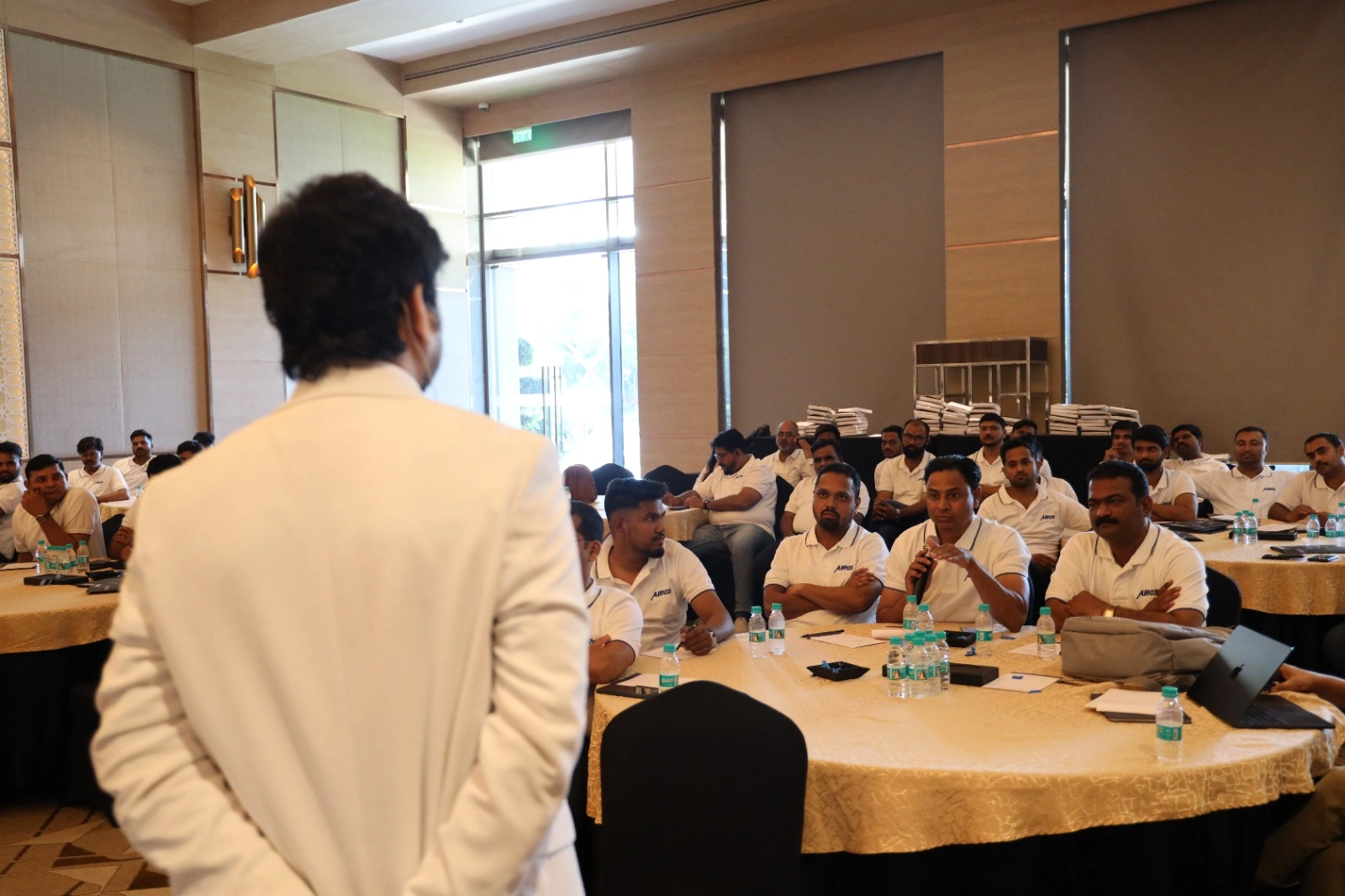
Walking operations and project leaders through the checklist discipline in one of my corporate workshops.The Day I Learned This the Hard Way
I do not teach this only from books. In 2018, I was anchoring a felicitation event in Aurangabad, and it taught me a lesson I have never forgotten.
A traffic jam delayed the start of the programme. Our chief guest, the Managing Director Mr Selvan, had to leave by 9:30 to catch a flight. Every piece of communication on stage that evening was flowing through me, and as the schedule slipped, the whole event tipped into chaos. We were improvising, scrambling, reacting.
Afterwards, a project manager on the team asked me a single quiet question that landed like a slap.
Did you use the checklist? You should have.
He was right. We had the experience, the talent and the goodwill. What we did not have was a one-page checklist with pause points for exactly this scenario. From that uncomfortable evening I distilled three lessons that I now build into every operations programme I run.
Three lessons every leader should keep
- Checklists handle complexity. The more moving parts an event, project or process has, the more a checklist earns its keep.
- Checklists reduce errors. They catch the simple, costly slips that talent alone will miss under pressure.
- Checklists instil discipline. They turn good intentions into a repeatable, shared standard that does not depend on any one person's mood that day.
This Is Not Theory, It Is How Serious Industries Run
When I make this case to sceptical managers, I point to the industries that simply cannot afford avoidable mistakes. Construction projects run on tools like MS Project and Primavera for scheduling, and on the RACI matrix to make accountability unambiguous. Step into a busy Mumbai restaurant kitchen during a Saturday dinner rush and you will find it running on checklists, station by station, because the cost of forgetting an order or a food-safety step is immediate and visible.
The principle is universal. Wherever the stakes are high and the steps are many, the professionals stop trusting memory and start trusting a list.
The two types you need to know
In my workshops I teach that there are essentially two kinds of checklist, and using the wrong one creates friction:
- Read-Do: you read each item and then perform the action, like following a recipe step by step. Best for unfamiliar or high-risk tasks.
- Do-Confirm: you complete the work from memory and expertise, then pause to confirm against the list that nothing was missed. Best for experienced teams doing familiar work.
The rules of a checklist that actually gets used
A bad checklist is worse than none, because it breeds contempt and gets ignored. A great one follows a few simple rules:
- Keep it to roughly five to nine items, the range our working memory comfortably holds.
- Fit it on one page, so it can be seen at a glance.
- Be precise, using clear and exact wording with no room for interpretation.
- Be practical and easy, so that using it feels faster than skipping it.
The Psychology: Why Your Brain Needs the List
Daniel Kahneman gave us a powerful way to understand why this works. He described two modes of thinking. System 1 is fast, automatic and intuitive, the mode we live in most of the day. System 2 is slow, deliberate and effortful, the mode that double-checks.
Under deadline pressure, almost all of us default to System 1, and that is exactly when the simple, costly errors slip through. A checklist is, in essence, externalised System 2 discipline. It forces a deliberate pause precisely when your tired, busy brain wants to rush.
A checklist does not insult your intelligence. It protects your intelligence from the moments when it is not paying attention.
A real result from this approach
When I applied this thinking to an employee-engagement project, my team and I built a fifteen-point checklist with four pause points. Two of the critical checks proved especially revealing: uncommunicated leaves, and the question of whether an employee had a good friend at work. These were not steps anyone would have called out from memory, yet they were quietly driving outcomes. The checklist surfaced what intuition had been missing.
Helping a team design their own one-page operational checklist during a hands-on session.Bring this to your team. I run checklist-focused and operational-excellence corporate training and keynotes for companies across Pune, Mumbai and all of Maharashtra.
Book a session · Explore corporate training programs
Frequently Asked Questions
Does using a checklist mean I do not trust my experienced team?
Not at all. A checklist is not a substitute for expertise, it is a guard for it. As I explain in my workshops, the most experienced surgeons and pilots in the world use checklists precisely because talent does not protect anyone from a forgotten step under pressure. The Do-Confirm type lets experts work from their own judgement and then simply confirm nothing was missed.
How long should a good workplace checklist be?
Keep it to roughly five to nine items on a single page. That range fits comfortably within working memory and stays usable. If your list is longer, you usually have several separate checklists hiding inside one, and they should be split by stage or pause point.
What is the difference between Read-Do and Do-Confirm checklists?
With a Read-Do checklist you read each item and then perform that action, which suits unfamiliar or high-risk work. With a Do-Confirm checklist you complete the task from memory and expertise first, then pause to confirm against the list. I help teams choose the right type for each process in my training sessions.
Can checklists really help with people problems, not just technical tasks?
Yes. When I built a fifteen-point checklist for an employee-engagement project, two of the most powerful critical checks were uncommunicated leaves and whether a person had a good friend at work. Checklists surface the soft, human factors that intuition tends to skip.
If a ninety-year-old index card can keep a complex aircraft in the sky, your team can certainly use one to protect its projects, margins and reputation. I would be glad to help you build checklists your people will actually use, so reach out through my contact page, see what I cover under corporate training, or learn more about my work. This article is adapted from my book The Winning Edge, The Champion Mindset.
Related Articles by Avinash Chate
- Why Manufacturing Industry is Difficult to Start in India: 5 Key Challenges
- Ajit Agarkar's 21-Ball ODI Fifty Against Zimbabwe: The Silent Performer's Career Blueprint
- Zero Defects: How Sundram Fasteners Won GM Supplier of the Year 5 Times
| AC | Avinash ChateIndia's Leading Corporate Trainer | TEDx Speaker | Author With 80+ organizations trained including RBI, JSW Steels, and Ferrero, Avinash Chate delivers high-impact corporate training across India. Creator of the KITE Leadership Framework and bestselling author of "The Winning Edge." Website YouTube |
Avinash Chate services
Corporate Trainer in Maharashtra · Top Corporate Trainers in Maharashtra · Leadership Trainer in Maharashtra · Top Leadership Trainers in Maharashtra · Motivational Speaker in Maharashtra · Top Motivational Speakers in Maharashtra · All service locations
← Back to all articles · Book Avinash Chate
By Avinash Chate — Maharashtra’s #1 Corporate Trainer & Motivational Speaker. .