13 Cards, 52 Weeks: Inside the Annual Staff Meet at Shivpratap Multistate Bank
A 2.5-hour Annual Staff Meet at Hotel Fern, Karad becomes the design brief for a year-long sales curriculum — 13 virtues, 13 fact-checked stories from Pike Place Fish Market to Anil Kumble's broken jaw, and one Marathi-grounded selling philosophy: तुम्ही product विकत नाही, समाधान देता.
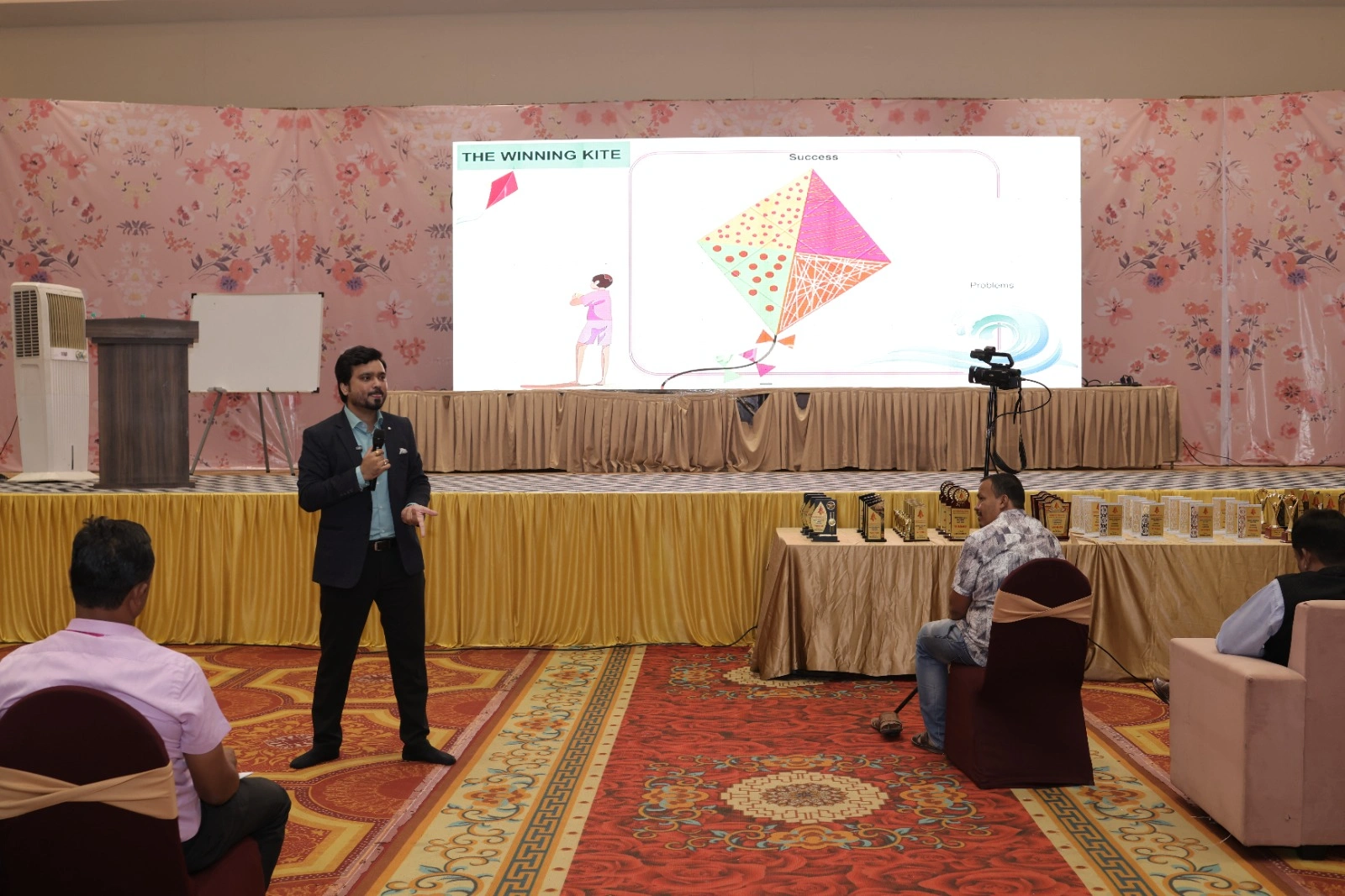
On Sunday, 17 May 2026, the team at Shivpratap Multistate Nagari Co-operative Credit Society — a 23-year-old institution serving over 2 lakh customers across 24 branches from its base in Vita, Maharashtra — gathered at Hotel Fern in Karad for their Annual Staff Meet and Excellence Awards. Branch managers, pigmy agents, recovery staff, back-office and women employees filled the hall. The brief I was handed was simple. The audience was anything but. What we built together over those 2.5 hours wasn't a sales pitch in disguise. It was the design brief for a year-long curriculum — 13 cards, 52 weeks, one selling philosophy rooted in Marathi soil.
TL;DR- Audience: ~200 staff across branch managers, pigmy agents, recovery, back office, women employees.
- Framework: Ben Franklin's 13 virtues × 4 cycles = 52 weeks. One virtue per week becomes a yearlong rhythm.
- Each staff member walked out with a physical pocket-sized 13-card pack — to be used as a weekly reflection prompt for the next 12 months.
- Themes covered: Sales, Marketing, Brand Pride, No-Comparison mindset — anchored in cooperative banking realities, not corporate jargon.
- Stories were fact-checked and intentionally mixed — 3 cricket moments, 5 Indian business journeys, 5 foreign cases. Each story = one mental hook for one virtue.
- Core thesis for cooperative banks: don't compete with HDFC/SBI on scale or rate. Compete on trust, family memory, and the customer's name being remembered.
Why 13 Cards? The Ben Franklin Formula Re-imagined for Cooperative Banking
Ben Franklin gave himself 13 virtues to track — temperance, silence, order, resolution, frugality, industry, sincerity, justice, moderation, cleanliness, tranquility, chastity, humility. He focused on one each week, cycled four times a year, and worked at it for the rest of his life. The maths is poetic: 13 × 4 = 52. One year of focused improvement. We borrowed the formula and asked the harder question — if a cooperative banker had 13 virtues to live by every week, what would they be? Not generic salesman skills lifted from a Western book. Not the same five-bullet pitch every trainer uses. Something rooted in cooperative banking realities. Something that worked on a recovery agent walking into a defaulter's living room, on a pigmy agent collecting ₹50 in the bylane, on a branch manager facing a customer who got a higher quote at the private bank across the road. We froze 13 cards. Each card carries 5-6 bullets — the why, the how, the what, the when. No story on the card. The story lives in the trainer's memory, the staff member's practice, the chai-time conversation. After the session, every staff member received a physical 95×68mm pack — slightly larger than an ATM card, designed to fit in a shirt pocket. The deal: one card per week, 13 cards per cycle, four cycles per year. A year of focused improvement on the rhythm Benjamin Franklin used for himself.
Card 1 — उत्साह: What a Seattle Fish Market Taught Cooperative Bankers About Energy
Pike Place Fish Market in Seattle was bankrupt in 1986. John Yokoyama had bought it for $3,500 in 1965 and run it for 20 years as, in his own words, a "grumpy dictator". A consultant named Jim Bergquist sat with the team. An employee made a single suggestion: "Let's become world famous." Yokoyama's response: "Why not?" Nothing else changed. Same fish. Same prices. Same location. What changed was attitude. The team started throwing fish across the counter. Singing. Calling customers by name. Cold smelly fish became theatre. Four years later they were on Good Morning America. By 1991, CNN ranked them among the three most fun workplaces in the world. The FISH! book sold 5 million copies in 35 languages. Today the market draws 10,000 visitors a day. Pike Place's principles became the operating manual of customer-facing businesses globally: choose your attitude, be there, make their day, play. Now look at a cooperative bank counter. Fluorescent light, AC running, polished marble floor, customer sitting across from you in a chair, not standing barefoot at a fish stall in Seattle drizzle. If a fish seller can find energy with cold wet hands at 7 AM, what excuse does a banker in air-conditioning have? That's the entire argument behind Card 1. उत्साह is not about being loud. It's about every customer feeling like they're the first customer of the day — at 9 AM, 1 PM, 5 PM, equally. The eye contact stays warm. The smile stays authentic. The tiredness from yesterday, the fight at home, the news on the phone — all of it stays behind the counter. Energy is the gateway to every other virtue. Without it, none of the other 12 cards work.
गर्व, मी शिवप्रताप: Royal Enfield's "Different Beats Better" Thesis Applied to Small Banks
In 1893, a needle factory in Redditch, England turned itself into a bicycle maker, and within a decade was making motorcycles. They called the company Royal Enfield. Their slogan since 1894 has been "Made Like A Gun." Their Bullet model has been continuously produced since 1932 — making it the longest-lived motorcycle design in motoring history. Now here's the story most Royal Enfield owners don't know. In 1970, the British factory shut down. Royal Enfield was dead in England. The brand survived only because the Madras factory in India — which had been making Bullets since 1955 for the Indian Army — refused to stop. By the late 1990s, Honda, Suzuki, Yamaha were eating the Indian market with better mileage, better speed, better price. Eicher Motors, which owned what was left of Royal Enfield, was about to shut down the brand entirely. Then a 26-year-old named Siddhartha Lal walked into the boardroom and said, "Give me a chance." His parents owned Eicher. He didn't use that for leverage. He used it for accountability. He shut down 13 of Eicher's 15 business lines to focus only on Royal Enfield. And then he made the decision that defines the entire brand to this day: he refused to compete on the metrics everyone else was competing on. "We will not compete on speed. We will not compete on mileage. We will not compete on price. We are not better. We are different." Today Royal Enfield sells over 900,000 motorcycles a year in 60+ countries. The Bullet is still in production after 93 years. Eicher is a ₹1,00,000 crore company. The Bullet didn't win because it was better. It won because it was different. Now apply that to cooperative banking. HDFC, ICICI, SBI — they have scale. Small private banks have rates. Microfinance has reach. A cooperative bank in Maharashtra cannot win on scale, cannot consistently undercut on rate, cannot match digital pyrotechnics. So stop trying. Don't say "we're better than HDFC". Say "we are different." Big banks know transactions. We know your father's name, your daughter's wedding plan, your shop's slowest month. That's not a feature. That's a moat. And Card 2 reminds every Shivpratap staff member of it every Monday morning: मी फक्त employee नाही — मी शिवप्रताप. Twenty-three years of trust built by Late Pratapshet Salunkhe — Dada — sits in your hands. Don't hold it apologetically.
विकू नका, मदत करा — Hilti's Lesson: We Don't Sell Drills, We Sell Holes
Hilti is a Liechtenstein-based tools company. By 1999, it was a $2 billion business famous for its red toolbox and its construction-grade drills. But internally, the company had a problem they couldn't solve. Their best customers — large construction companies — were unhappy. Why? On any given site, 30 tools were missing. 50 were broken. 20 were outdated. Storerooms were full of half-working equipment. Projects were getting delayed because the right tool wasn't at the right place at the right time. A Hilti executive said something out loud in the year 2000 that changed everything. "Our customers don't want to buy drills. They want holes. They want projects finished. We're selling them headaches." Then he asked the question that broke the model: "What if we stop selling tools and just help them finish projects?" That question became Hilti Fleet Management. Customer pays a monthly fee. Hilti owns the tools. Tool breaks — free replacement next morning. Tool lost or stolen — free replacement. New model launched — free upgrade. Need 50 more tools for a six-week phase — Tools On Demand, delivered in 3 days. Project over — return them, stop paying. By 2015, Hilti was managing 1.5 million tools across 40 countries with $1.4 billion in fleet contracts. Customer loyalty was 5× higher than the buy-and-own model. The most famous internal quote at Hilti is still: "We don't sell drills. We sell holes." Card 5 takes that exact transposition into the cooperative banking aisle. A farmer doesn't want a pigmy account — he wants his daughter's wedding paid for in 18 months. A shopkeeper doesn't want a gold loan — he wants his business to scale through Diwali. A young couple doesn't want a recurring deposit — they want their child to study in Pune. Stop selling schemes. Start selling dreams. The minute a staff member's opening question shifts from "Pigmy account khulayla aavadel ka?" to "मुलीच्या लग्नासाठी किती हवं?" — the whole conversation changes. Customer remembers treatment, not transaction.
| Dimension | Big Private Bank Approach | Shivpratap Approach |
|---|---|---|
| Customer Identity | Account number | सुनिता ताई, mother of two, lives in lane 4 |
| Opening Question | "Pigmy account khulayla aavadel ka?" | "मुलीच्या लग्नासाठी किती हवं?" |
| Competitive Edge | Scale, technology, brand | Trust, family memory, name recognition |
| Customer Lifetime | Transaction-based, churn-tolerant | 3-generation relationship |
| Objection Response | Apology + discount | Reframe via Feel-Felt-Found (Card 11) |
| Training Cadence | Annual offsite, 1 day, mostly forgotten by Day 14 | 52-week pocket-card curriculum, 4 cycles a year |
Listening as the Deepest Form of Giving: Matsushita + Chris Voss
Konosuke Matsushita was born in 1894 in a poor farming village in Japan. His family lost their fortune when he was four. At nine, he was sent to a bicycle shop as an apprentice — total formal schooling: four years. At 22, his boss told him his improved electric socket design was useless. In 1917, he quit and started his own company in a two-room rented house in Osaka with $50 in capital, his wife Mumeno, and his brother-in-law. His wife pawned her kimono to buy rice. Out of that house grew Panasonic. The company that, by his death in 1989, was worth $42 billion. His personal fortune at the end was $3 billion. He wrote 44 books. They sold over 4 million copies. In Japan, he is still called the God of Management. He built it all on a single belief: "Every worker knows something I don't. My job is to listen." He walked the factory floor daily. He installed suggestion boxes everywhere. He read every single suggestion himself. In 1929, during the Great Depression, his executives told him to fire half the workforce. He said: "Cut production in half. Don't fire anyone. Pay full wages. Half-day in the factory, half-day on the streets selling backlog." Two months later, all inventory was sold. In 1946, after Japan's defeat in World War II, the American occupation tried to remove him as president of the company. 15,000 employees signed a petition: "You can take the company. But you cannot take him. He listens to us." The Americans backed down. Now layer on top of Matsushita's philosophy the practical mechanics. In 1993, an FBI negotiator named Chris Voss walked into a Brooklyn bank hostage situation. Three hostages. A robber named Chris Watts who had just put a gun in a teller's mouth and pulled the trigger on an empty chamber. Voss had no rapport, no leverage, no time. He used a technique called mirroring — repeating the last three words of whatever the robber said, in a calm "late-night FM DJ" voice, and then waiting in silence for four seconds. Robber: "I want a million dollars and a getaway car!" Voss: "...a getaway car?" Silence. The robber paused. Then explained. Then revealed his fears. Then surrendered — the first hostage-taker in NYPD history to give up without a shot fired. All three hostages walked out alive. Voss handled 150 international hostage cases over 24 years using the same three tools: mirroring, late-night FM DJ voice, and four-second silence. His book Never Split the Difference has sold over 5 million copies. Apple, Microsoft, and Google use his methods in negotiation training. Now combine Matsushita's philosophy with Voss's mechanics, and you get Card 6. ऐकणं is not passive. Listening is the highest form of giving — the only commodity in the cooperative bank's arsenal that the digital banks can't replicate at scale. Eighty per cent the customer talks. Twenty per cent the banker talks. No interrupting. Ask "why" twice. When Mrs. Patil walks in and says "मला loan पाहिजे" — don't reply with rates. Mirror: "Loan पाहिजे... कशासाठी?" Then silence. She'll tell you about her daughter's wedding, her husband's hospital bill, her family's dream. That answer is the beginning of a three-generation relationship.
First 30 Seconds: The Rishabh Pant Gabba Rule for Branch Counters
On 19 January 2021, Australia hadn't lost a Test match at the Brisbane Gabba in 32 years. Not since 1988. India had just been bowled out for 36 — their lowest-ever Test total — in Adelaide a few weeks earlier. India walked into the Gabba with their backup eleven: a half-dozen injured, a captain back home, fresh debutants making their first Test starts. The hosts were so confident they didn't even prepare a green pitch. India won. Chasing 328 on day five, they got home with three wickets and three overs to spare. The architect was a 23-year-old named Rishabh Pant. He came in at 167 for 3 with a mountain still to climb. He played 138 balls. Made 89 not out. Played one shot that has been replayed more times than any other in Indian Test cricket — a stand-and-deliver six off Nathan Lyon over long-on in the 90th over of the day. ESPNcricinfo called it the Test Innings of the Year. Now look at how Pant walked in. Before the first ball, before any tactic, before any line, he had to set a tone. His first 30 seconds at the crease decided whether he was going to chase the target or save the draw. He chose. The body language. The eye contact with the bowler. The deliberate slowness with the gloves. The single nod to the keeper. Forty per cent of how Pant played that innings was decided in his first 30 seconds. Apply that to a Shivpratap branch counter. Inside the first 30 seconds, the customer has made up their mind about three things: do I trust you, do you respect me, and are you actually paying attention. The 7-38-55 rule of Albert Mehrabian says only 7% of that judgment comes from your words. 38% from your tone of voice. 55% from your body language and eye contact. You haven't finished saying "नमस्कार" yet. The first 30 seconds are non-negotiable: smile, eye contact, phone face-down, screen pushed aside, full attention. If you're mid-something and a customer walks in, don't freeze in silence — "नमस्कार, एक मिनिट" and acknowledge them. New customer, ask their name. Old customer, greet by name. This is Card 9.
Names, Faces, Family: Joe Girard's 13 Cards (and a Beautiful Coincidence)
In 1963, a 35-year-old man in Detroit named Joe Girard walked into a Chevrolet dealership and begged for a job. He had failed at everything until that point — 40 jobs in 15 years, a divorce, bankruptcy, a broken family. The dealership manager refused. Joe waited at the dealership the entire next day until the manager relented and gave him one chair, one phone, and one warning: "If you don't sell anything in 30 days, you're out." Joe sold 18 cars in his second month. Then he kept going. From 1963 to 1978, Joe Girard personally sold 13,001 cars. His best year, 1973, he sold 1,425 cars — almost four cars every working day. Guinness World Records named him the world's greatest salesman 12 years running. His secret was not technique. His secret was 13 greeting cards per year, per customer. Every month, a different card. Different colour. Different design. Same message: "I LIKE YOU." That's it. No promotional offer. No new-model push. Just three words. Joe sent 13,000 cards a month at his peak. He paid two assistants out of his own pocket to keep the cards going out. Customers brought their children. Then their grandchildren. Three generations of one family bought every car from Joe Girard. Now here's the beautiful coincidence we built the Shivpratap session around. Joe Girard sent 13 cards a year. We gave every Shivpratap staff member a pack of 13 cards. Joe's cards were for his customers. Our cards are for the staff member's own discipline. Two different uses of the same number. Both pointing at the same truth: persistence + attention + warmth = a lifetime customer relationship. Card 10 asks every Shivpratap staff member to do what Joe Girard did at scale — note down one personal detail per new customer. Notebook, CRM, sheet, doesn't matter. "नमस्कार सुनिता ताई, अमित कसा आहे शाळेत?" Five seconds of effort. Five generations of trust. The cooperative bank's entire business model rests on this kind of memory.
प्रामाणिकपणा: Dr. Y. V. Reddy and the Bank that Saved a Nation
In mid-2000s, the world was going crazy with derivatives, sub-prime mortgages, and structured products that nobody understood. American banks were levering up 30 times their capital. European banks were doing the same. The US Treasury, the IMF, the World Bank were all telling India to deregulate — let the banks do what they want, the market knows best. India's Reserve Bank Governor at the time was Dr. Y. V. Reddy. A quiet Telugu-speaking economist who had risen through IAS and the RBI. He refused. His sentence, repeated in private and in public boardrooms, was: "Bankers given a chance to sin, will sin." He raised provisioning. He capped real-estate lending. He banned banks from holding derivatives they couldn't value. He resisted pressure from his own government and from international institutions. He was called old-fashioned, paranoid, anti-growth. Then September 2008 happened. Lehman Brothers collapsed. The global meltdown began. Bear Stearns gone. Merrill Lynch sold for parts. AIG bailed out. US banks lost $1 trillion. South Korea took a $130 billion bailout. Europe entered its sovereign-debt spiral. What happened to India? India's total toxic-asset exposure across the entire $500 billion banking system was less than $1 billion. Zero bailout. Economy still grew at 6.7% in the worst year. The New York Times in December 2008 carried a piece crediting Dr. Y. V. Reddy by name with single-handedly saving India's banking system. His book "Advice and Dissent" published in 2017 is a quiet 400-page proof that one banker's honesty saved a nation's economy. Now bring that home to Shivpratap. One banker's integrity saved a country. One Shivpratap staff member's integrity can save a family. Telling a customer "this scheme is not right for you" instead of pushing the higher-commission product. Disclosing the actual interest rate, not the marketing number. Returning a wrong-direction transfer the same day. Refusing a fake commitment even when the customer asks for it. Card 13 lives at the bottom of the pack for a reason — without it, the other 12 cards are tricks. With it, they're a foundation. प्रामाणिकपणा is what makes a 23-year-old cooperative bank survive into its 50th year. And the customer is never one transaction. The customer is one generation, then the next, then the next.
From Session to Curriculum: How 13 Cards × 52 Weeks Builds a Lifetime
The session ended at 1 PM. Tea was served. Cards were handed out — one pack of 13 per person, designed at 95×68mm, printed on 300 GSM cardstock with a burgundy and gold colour scheme, laminated, slightly larger than an ATM card, designed to fit in a shirt pocket. The deal we made with the room: one card per week. Read it in the morning. Practise it on the counter through the day. Reflect on it before sleeping. The next week, the next card. Thirteen weeks later, cycle restarts. Four cycles. Fifty-two weeks. One year. Then start the next year on Card 1 again — because the virtues don't expire, the practice deepens. Why does this beat a one-day sales workshop? Because one-day workshops have a half-life of about seven days. Most participants forget 70% of what they heard by week two. Worksheets get filed in a folder. Slides get archived in a Google Drive. The behaviour reverts. A 13-card system survives because the prompt is in the pocket, not in the folder. The reminder fires every morning when the wallet comes out. The vocabulary becomes shared — when the branch manager says "Card 5" in a meeting, everyone in the room knows what they're talking about: stop selling, start helping. That shared vocabulary is what turns a 200-person workforce into one coherent culture over 52 weeks. We're recording 13 short Instagram reels — one for each card, one for each week — that the Shivpratap social media team can amplify to their own customers and members. The cards themselves carry the avinashchate.com footer, so they're also a marketing artefact for the bank's membership drive. The session is one event. The curriculum is one year. The cards are one decade. That's the actual ROI of a corporate training session done properly. Not a one-day mood lift. A piece of infrastructure inside the institution.
Book Avinash Chate for Your Next Event
TEDx speaker. 11+ yrs training Army, BRO, RBI, BARC, JSW. Available for keynotes, leadership training, team building & manager development at your office or event venue.
✅ Thanks! Avinash team will reach out within 24 hours.'}).catch(function(e){f.outerHTML='Something went wrong. WhatsApp +91 8793630001
'});return false;">Select ServiceKeynote / Motivational SpeakingLeadership Development TrainingTeam Building WorkshopManager DevelopmentEmployee TrainingOutbound TrainingBook Avinash Now →Or WhatsApp directly: +91 87936 30001
Related Articles by Avinash Chate
- 9 Real Reviews from Shivpratap Multistate Bank — What 200 Bankers Said About the Annual Staff Meet 2026
- AB de Villiers' 31-Ball Century: Creative Freedom Lessons India 2026
- Desert Storm 143: Sachin Tendulkar's Adaptability Lessons India 2026
Avinash Chate TEDx Speaker · Founder, The Future Corporate · 11+ yrs experience Avinash has trained Indian Army, BRO, RBI, BARC, JSW Steel and 1000+ corporate leaders across India. His work focuses on leadership development, communication skills, and behavioural training rooted in Indian values and modern business needs. |
Frequently Asked Questions
What is the 13 Cards System and how was it developed?
The 13 Cards System is an adaptation of Benjamin Franklin's 13-virtues self-improvement framework — Franklin tracked one virtue per week, cycled four times per year, for the rest of his life (52 weeks = one full year). For Shivpratap Multistate Nagari Co-operative Credit Society's Annual Staff Meet in May 2026, I redesigned the framework specifically for cooperative bankers. The 13 cards cover Sales, Marketing, Brand Pride, and No-Comparison mindset — themes most relevant to small-bank survival against larger competitors. Each card has 5-6 actionable bullets in Marathi-English mix, with no stories printed on the card itself. Stories live in the trainer's memory and the staff member's practice. Cards are printed at 95×68mm on 300 GSM cardstock with burgundy-gold branding, slightly larger than an ATM card, designed to fit in a shirt pocket. Each staff member walks out of the session with a physical pack — one virtue per week becomes a year-long rhythm.
Why does a 52-week card-based curriculum work better than a one-day sales training?
Most one-day sales training programmes lose 70% of their content within 14 days. Worksheets get filed. Slides get archived. Behaviour reverts to baseline within a fortnight. The 13 Cards System survives because the prompt is in the pocket, not in the folder. Every morning when the staff member pulls out their wallet, the current week's card is right there. The reminder is constant. Over 52 weeks, a shared vocabulary develops across the institution — when a branch manager says "Card 5" or "Card 11" in a team meeting, everyone in the room understands the context without explanation. That shared vocabulary is what transforms a 200-person workforce into one coherent customer-facing culture. One day delivers a mood lift. 52 weeks delivers a culture shift.
Can the same 13 Cards framework apply to private banks or NBFCs, or is it only for cooperative banks?
Yes, the framework adapts beautifully — but the content of each card has to be redesigned for the specific institution. For a private bank, the brand-pride card might anchor on the bank's digital edge instead of cooperative-banking heritage. For an NBFC, the listening card might lean on credit-history conversations rather than pigmy-collection visits. For a microfinance institution, the names-and-faces card might focus on group lending dynamics. The core architecture — 13 cards, 52 weeks, fact-checked stories, pocket-sized physical cards, Ben Franklin's cycling rhythm — stays. Only the content changes. I have built versions for cooperative banks, manufacturing companies, BPOs, education institutions, and family-run businesses. Each version is a 6-week design engagement before the actual training day.
How can our cooperative bank or financial institution get a similar customised Annual Staff Meet session with Avinash Chate?
The fastest path is to write to my team at connect@avinashchate.com or WhatsApp +91 8793630001 with three pieces of information: (1) the institution's background and approximate workforce size, (2) the strategic priority for the next 12 months — sales, leadership, customer service, brand-pride, or all four, and (3) a preferred date window. We typically need 6 weeks between confirmation and delivery — that's how long it takes to design the 13 cards specifically for your context, fact-check the 13 stories, print the physical card packs, and prepare the speaker reference guide. Sessions can be delivered in Marathi, Hindi, or English depending on the audience. Most engagements include the physical card packs for all staff, a Session Reference Guide PDF, post-session Instagram reels for the institution's social media, and a 90-day check-in call to track behaviour change.
Avinash Chate services
Corporate Trainer in Maharashtra · Top Corporate Trainers in Maharashtra · Leadership Trainer in Maharashtra · Top Leadership Trainers in Maharashtra · Team Building Trainer in Maharashtra · Top Team Building Trainers in Maharashtra · Motivational Speaker in Maharashtra · Top Motivational Speakers in Maharashtra · All service locations
← Back to all articles · Book Avinash Chate
By Avinash Chate — Maharashtra’s #1 Corporate Trainer & Motivational Speaker. .