Trust the Process: How Kasparov, Tendulkar, and Ronaldo Stayed Patient Through Slow Progress
Kasparov, Tendulkar and Ronaldo all shared one uncommon discipline: they trusted the process when results were invisible. Here is what that means for Indian professionals.
Let me ask you a question I ask every audience I speak to across Maharashtra: What do Garry Kasparov, Sachin Tendulkar, and Cristiano Ronaldo have in common? Most people say talent. Some say hard work. But the real answer — the one that separates champions from everyone else — is that all three of them mastered the art of trusting the process when absolutely nothing seemed to be working.
In my book The Winning Edge, The Champion Mindset, I devote the very first chapter to what I call the Apprenticeship Model. It is a three-stage framework: Passive learning, Active Practice, and Mastery. The stage that breaks most professionals — students, managers and business owners alike — is not the final stage. It is the middle stage, the Practice stage, where results are slow, invisible, or even negative. This article is drawn from that chapter, and from the stories I share in my corporate training workshops across Pune, Mumbai and the rest of India.
If you are someone who has started something important — a new role, a new skill, a new business — and you feel frustrated because you cannot yet see results, this is the article you need to read today.
The Hardest Psychological Challenge in Any Journey
In every workshop I run, I ask participants to close their eyes and remember a time they quit something too early. Almost every hand goes up. We quit because we believe the absence of visible results means the process is broken. We assume that if we were doing the right things, we would see the numbers move, the promotions come, the sales close. But that is not how mastery works.
The Passive stage is where you observe, absorb, and learn from those around you. The Practice stage is where you apply what you have learned — repetitively, deliberately, and often without applause. The Mastery stage is where the world finally sees you. But here is the brutal truth I share in The Winning Edge: you cannot reach Mastery without first surviving Practice. And surviving Practice requires one specific psychological skill — the ability to trust the process.
"The dots only connect looking backwards. But you have to keep drawing them forwards, in the dark, in the silence, when no one is watching."
— from my book, The Winning Edge, The Champion Mindset
This is not motivational fluff. It is a cognitive discipline, and the greatest performers in history have demonstrated exactly what it looks like.
Kasparov: Studying Openings He Already Knew
Garry Kasparov was the World Chess Champion — arguably the greatest chess player who ever lived. And yet, even at the peak of his powers, he spent hours every single day studying chess openings. Openings he had already memorised. Sequences he had already played thousands of times.
Why? Because Kasparov understood something that most professionals resist: the process must be fixed even when results are not. He did not study chess openings only when he felt he needed to improve. He studied them every day because the daily commitment to the process was the source of his competitive edge, not a reflection of his current weakness.
The Lesson for Indian Professionals
- Do not wait for a performance review to sharpen your skills. Build a fixed daily practice — even 30 minutes — and protect it.
- Boredom during repetition is not a signal to stop. It is a signal that your conscious mind is being freed up so your deeper competence can grow.
- Kasparov was already a champion when he sat down to study. That is precisely why he remained a champion.
I tell this story in my leadership workshops because most managers believe that once they reach a senior level, the learning phase is over. Kasparov destroys that illusion completely.
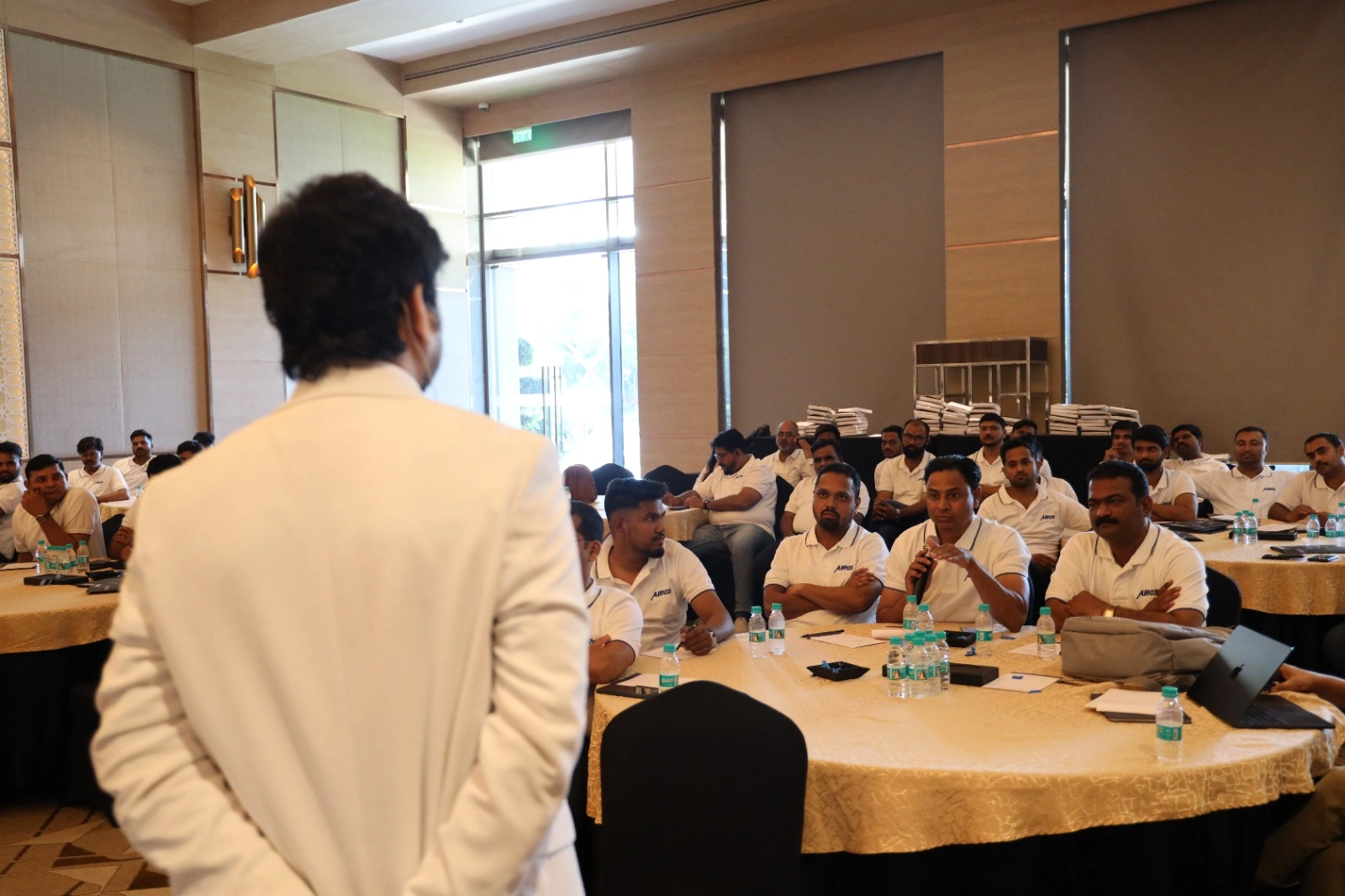
Avinash Chate sharing the champion mindset framework with corporate teams — discipline and daily practice are the foundation of every high-performer.Tendulkar: The Same Cover Drive, Ten Thousand Times
Sachin Tendulkar is a name that needs no introduction in India. But here is a detail about him that I find endlessly instructive: Tendulkar practised the same cover drive thousands upon thousands of times. Not because he had not mastered it — he had. He did it because he understood that a skill not reinforced is a skill that decays.
In my workshops I often say: Tendulkar did not practise until he got it right. He practised until he could not get it wrong. That is a fundamentally different standard, and it is the standard that separates the very best from everyone else.
What Child-Like Curiosity Actually Looks Like
There is another quality all three of these champions share — something I describe in The Winning Edge as child-like curiosity. Children do not practise walking and then quit because they fell down five times. They are curious about what happens when they try again. They have no ego investment in the outcome of a single attempt. They stay attached to the exploration, not the result.
- Tendulkar approaching a cover drive with child-like curiosity means asking: "What tiny adjustment makes this five percent better today?"
- For a sales professional, it means: "What did I learn from this rejection that I can apply to the next call?"
- For a manager, it means: "What one thing can I do differently in this team meeting today to make it more productive?"
"Curiosity keeps you in the game long enough for the process to work. Impatience pulls you out before the compound interest of effort kicks in."
— from my book, The Winning Edge, The Champion Mindset
The Indian Professional Context
In the Indian corporate environment, I see a particular kind of pressure that works against the process mindset. We are a results-first culture — quarterly targets, annual appraisals, visible metrics. These are not wrong in themselves. But they create an environment where the invisible work of the Practice stage is chronically undervalued. A salesperson who is quietly building relationship skills does not show up on a Q2 dashboard. A manager who is deliberately practising listening is not immediately measurable. Yet these are precisely the practices that compound into extraordinary performance over time.
Ronaldo and Beckham: Staying Back When Everyone Else Goes Home
Cristiano Ronaldo and David Beckham are both cited in The Winning Edge as exemplars of the same principle, and I pair them deliberately because they practised the same thing: free kicks and shooting, after every team training session, when everyone else had already gone home.
Think about what that means psychologically. The training session is over. The coach is done. Your teammates are in the changing room. Your body is tired. And yet Ronaldo and Beckham both had a fixed practice that they could not be talked out of. No one was watching. No cameras were rolling. No headline would be written about those extra minutes. The result of that session — those free kicks hit against an empty net — would not show up on a scoreboard for weeks or months.
Three Principles I Teach From This Story
- Fixed practice survives mood. Ronaldo did not stay back only when he felt motivated. He stayed back because it was his process. If your practice depends on how you feel that day, it is not a practice — it is a hobby.
- The unseen work is the real work. Every signature performance that millions of people watch has thousands of invisible hours behind it. The ratio of hidden effort to visible result is always far higher than people imagine.
- Process builds identity, not just skill. When staying back after training becomes who you are — not just what you do — you have crossed from practice into mastery.
I have run corporate training programmes for teams across Pune, Mumbai, Nashik and beyond, and I have seen this principle transform individuals who were stuck in mediocre performance cycles. The moment they shifted from outcome focus to process focus, something unlocked.
The Three Stages and Where Most People Quit
Let me map the Apprenticeship Model from Chapter 1 of The Winning Edge directly onto the stories above, so you can locate yourself on this journey.
Stage 1: Passive Learning
This is the observation phase. You are watching, absorbing, asking questions, studying the masters. Kasparov as a child watching older players. Tendulkar watching Sunil Gavaskar on television. Ronaldo studying footage of the greatest strikers. In your professional life, this is your first year in a new role, a new industry or a new skill. The work here is to stay humble and curious, not to perform.
Stage 2: Active Practice (Where Most People Quit)
This is where the real battle is. You have absorbed the knowledge. Now you are applying it — and the results are not matching the knowledge. This gap between knowing and performing is the Practice stage. It is uncomfortable, often embarrassing, and always invisible to the outside world. This is where Kasparov still studied openings. Where Tendulkar hit the same drive again. Where Ronaldo and Beckham stayed back. This is where champions are actually made, not in the spotlight of Stage 3.
Stage 3: Mastery
Mastery is the stage the world sees and celebrates. But it is not a destination so much as a moving horizon. Kasparov at his peak was still a practitioner. Tendulkar in his final years was still curious. This is the paradox at the heart of The Winning Edge: mastery does not end the process. It deepens your commitment to it.
"Most people want the trophy without the training. But the training is the trophy — it is where you become the person capable of holding it."
— from my book, The Winning Edge, The Champion Mindset
How to Build Your Own Process — A Practical Framework
The stories of Kasparov, Tendulkar, Ronaldo and Beckham are inspiring. But inspiration without application is entertainment. In my workshops, I always end with a practical framework, and I will do the same here.
Step 1: Identify Your One Core Practice
Tendulkar did not practise everything every day. He had a core practice — the cover drive, his signature shot — that he reinforced relentlessly. What is your equivalent? For a sales professional, it might be the discovery call. For a manager, it might be the one-on-one conversation. For a student, it might be solving problems without looking at the answers first. Identify it and protect it.
Step 2: Set a Fixed Time, Not a Variable Intention
Ronaldo stayed back after training. Every session. Fixed time, fixed habit. Variable intentions — "I will practise when I have time" — do not survive the pressures of a busy professional life. In India especially, where we carry enormous family, social and professional obligations, the only practice that survives is the one that is scheduled like a meeting you cannot cancel.
Step 3: Measure Process, Not Just Outcome
Create a simple log. Did you do the practice today? Yes or no. After 30 days, your log is your evidence. Not that you have achieved mastery — but that you are becoming someone who trusts the process. That identity shift is worth more than any single result.
Step 4: Find a Child-Like Question for Each Session
Before every practice session, ask yourself one curious question. Not "Will this work?" but "What will I notice today?" This is the child-like curiosity I describe in The Winning Edge. It keeps you engaged with the process rather than fixated on the outcome. Kasparov asked: "What do I see in this position that I have not seen before?" That question kept a world champion curious for decades.
Bringing the champion mindset to corporate teams — the process framework that Kasparov, Tendulkar and Ronaldo all lived by, applied to Indian professionals.Bring this to your team. I run process-mindset and champion-mindset focused corporate training and keynotes for companies across Pune, Mumbai and all of Maharashtra.
Book a session · Explore corporate training programs
Frequently Asked Questions
What does "trust the process" actually mean in a professional context?
Trusting the process means committing to a fixed daily practice and measuring your consistency — not just your outcomes. It means accepting that skill-building has a lag: the work you do today shows up in your results weeks or months later. In my corporate training workshops, I teach professionals to track process metrics (did I do the practice?) separately from outcome metrics (did I hit the target?). Kasparov, Tendulkar and Ronaldo all maintained fixed daily practices regardless of recent results, and that consistency is exactly what produced their extraordinary outcomes over time.
How do I stay motivated when I put in the work but see no results?
Motivation is an outcome of progress, not its cause — and in the Practice stage, progress is invisible. The champions I write about in The Winning Edge solved this problem not by chasing motivation but by building identity. Ronaldo did not ask himself whether he felt like staying back after training. It was simply who he was. I coach professionals to make the same shift: instead of saying "I need to practise my presentation skills," say "I am someone who rehearses every presentation." Identity-based practice does not depend on how you feel today. It depends on who you have decided to become.
Can this mindset be taught in a corporate training programme?
Absolutely — and this is precisely what I teach in my workshops across Pune, Mumbai and Maharashtra. The champion mindset is not a personality trait that some people are born with and others are not. It is a set of learnable psychological skills: process commitment, child-like curiosity, identity-based habit formation, and delayed-gratification tolerance. Over the course of a structured workshop, teams can identify their core practices, build fixed routines, and develop the self-awareness to recognise when they are in the Passive, Practice or Mastery stage of any new skill. The transformation I have seen in corporate teams is real and measurable.
Why do some talented people plateau while less talented people keep improving?
This is one of the central questions in The Winning Edge, and the answer consistently comes back to process versus outcome orientation. Talented people often reach a comfortable level of performance and unconsciously stop practising because results are coming in. Less talented people who are committed to the process keep practising, keep iterating, keep asking child-like questions — and they compound their way past the early-talent advantage. Tendulkar was extraordinarily gifted, but so were many players who never reached his level. What separated him was his willingness to practise the same shot thousands of times even when the talent alone might have been sufficient.
If this framework has resonated with you, I would love to bring it to your team. Reach out through the contact page or explore my corporate training programs — and if you want to understand the full Apprenticeship Model, visit my signature programs where this and every other chapter of The Winning Edge comes alive in an interactive, application-focused format. Every session I design is built around one conviction: the process is not the path to the goal — it is the goal.
This article is adapted from my book The Winning Edge, The Champion Mindset.Related Articles by Avinash Chate
- Recession मध्ये Hyundai ने cars परत घेऊनही फायदा कसा कमावला
- Virender Sehwag Mindset That Most Corporate Professionals Fear
- Ajit Agarkar's 21-Ball ODI Fifty Against Zimbabwe: The Silent Performer's Career Blueprint
| AC | Avinash ChateIndia's Leading Corporate Trainer | TEDx Speaker | Author With 80+ organizations trained including RBI, JSW Steels, and Ferrero, Avinash Chate delivers high-impact corporate training across India. Creator of the KITE Leadership Framework and bestselling author of "The Winning Edge." Website YouTube |
Avinash Chate services
Corporate Trainer in Maharashtra · Top Corporate Trainers in Maharashtra · Leadership Trainer in Maharashtra · Top Leadership Trainers in Maharashtra · Motivational Speaker in Maharashtra · Top Motivational Speakers in Maharashtra · All service locations
← Back to all articles · Book Avinash Chate
By Avinash Chate — Maharashtra’s #1 Corporate Trainer & Motivational Speaker. .