Best Corporate Trainer in Navi Mumbai
Organisations seeking a corporate trainer in Navi Mumbai can evaluate Avinash Chate through his TEDxBEC speaker record, published books, the KITE Leadership Framework and source-backed engagements. Bookings are confirmed after the dates, travel and brief are agreed; sessions run in English, Hindi and Marathi.
KITE Leadership Framework · English, Hindi and Marathi · Booking and pricing guide
Built for Navi Mumbai's Industries
A planned corporate city — IT/ITeS parks in Airoli and Vashi, the JNPT logistics ecosystem, a growing data-centre cluster, and the upcoming international airport reshaping the MMR economy.
Programs can be scoped for IT/ITeS, Logistics (JNPT), Data Centres, BFSI teams in Navi Mumbai, with booking availability and travel confirmed around your dates and local business context.
Browse all service locations and city pages →
Business Areas Covered in Navi Mumbai
Engagements can be planned for teams working across Airoli, Vashi, Rabale MIDC, Belapur CBD, with the final venue, travel and delivery format confirmed around the organisation's brief.
Based in Pune, Chhatrapati Sambhajinagar and Sangli — Available Across India
Avinash Chate works from three bases in Maharashtra — Pune, Chhatrapati Sambhajinagar (Aurangabad) and Sangli — so a Navi Mumbai program is served from within the state, and he also delivers pan-India and internationally. Dates, travel and the brief are agreed before a booking is confirmed, and sessions run in English, Hindi and Marathi.
Corporate Training Workshops and Programs in Navi Mumbai
Organisations comparing corporate training companies in Navi Mumbai can evaluate the workshop format, leadership objective, industry context, language, facilitator record and follow-through. Avinash Chate's personal corporate-training practice can be scoped for corporate training workshops and programs in Navi Mumbai, from keynotes and half-day or full-day workshops to leadership cohorts, team building, sales and behavioural programmes, once the dates, travel and brief are agreed.
- Corporate training workshops for leadership, sales, behavioural change, emotional intelligence and team collaboration.
- Corporate training programs for first-time managers, senior leaders, cross-functional teams and high-potential cohorts.
- A practical way to compare team building companies in Navi Mumbai: check the facilitator's evidence, safety and activity design, business relevance, language fit and post-session reinforcement.
Compare corporate training companies in Navi Mumbai
For a comparison-led brief, review the Top Corporate Trainers in Maharashtra. It is a first-party guide for comparing evidence, audience and industry fit, delivery format, language and post-program reinforcement before requesting a proposal.
The grid city that actually filled in
Navi Mumbai was drawn on a grid by CIDCO half a century ago. Unusually for Indian planning, the grid filled in with real employers. Vashi matured first and still holds banks, trading offices and the infotech-era buildings around the station complex. Belapur's CBD carries the administrative and financial weight. And along the Thane–Belapur Road, the TTC industrial corridor runs node after node, Airoli, Rabale, Ghansoli, Mahape, Turbhe, mixing older factories with some of the region's largest office campuses.
The scale is easy to underestimate. From across the creek it looks smaller than it is. Mindspace's Airoli East and West campuses rank among the biggest business parks in the region, Millennium Business Park at Mahape houses a dense IT and services population, and Reliance runs its enormous corporate campus at Ghansoli. These floors hold delivery teams, BPO and KPO operations, corporate functions and engineering centres, with a striking number of recently minted managers among them.
It is also, culturally, a CIDCO city: Marathi at its civic base, Hindi as the working bridge, English on the office floors, with a workforce drawn from the whole region across the harbour line and the trans-harbour corridors. Teams here are commuter-realistic and shift-hardened. They spot imported, city-agnostic training content within minutes.
Half of India's containers pass the doorstep
At the southern end sits Jawaharlal Nehru Port at Nhava Sheva, India's largest container port, handling roughly half of the container traffic that moves through the country's major ports. Around it spreads the working belt the port creates: container freight stations, bonded warehouses, transport yards and customs-broking offices across Dronagiri, Uran and Panvel, an economy that runs twenty-four hours and hires accordingly.
Training briefs from this belt are unglamorous and specific: shift supervisors who must hold discipline across drivers, tally clerks and equipment operators; documentation teams where one error cascades into demurrage; safety conversations that have to work in Hindi and Marathi in the middle of a yard, not in English on a slide. It is the kind of work a trainer either respects or fails at. It cannot be served with a corporate deck and a laser pointer.
The port economy also manufactures first-time managers as reliably as it moves boxes. Every new yard and warehouse rising toward the airport means another dozen people promoted to shift-in-charge, most of them strong operators who have never been taught to run people. That is the standing gap in this belt, and it compounds every year the belt grows.
Data halls and an airport are rewriting the belt
Two newer forces are reshaping the corridor. The first is data centres: the Mahape–Airoli stretch has become one of the country's densest data-centre clusters, with AirTrunk, STT GDC and NTT building major capacity in Mahape and Sify long established at Airoli. The second is the airport: Navi Mumbai International Airport began commercial flights in December 2025 and added its first international service in mid-2026, while the Atal Setu bridge now puts south Mumbai within commuting distance of Ulwe and Panvel.
Growth at that speed has a predictable human cost: organisations promote faster than they develop. Team leads are appointed mid-quarter. Supervisors inherit doubled headcounts. The gap between designation and capability widens with every hiring cycle. That gap, not any slide about leadership, is what a serious training engagement here is hired to close.
What month one looks like for a new shift-in-charge
A promotion letter changes a man's designation on a Monday and nothing else about him. In month one the new shift-in-charge does exactly what a competent operator does under pressure. He does the work himself. A machine misbehaves and he fixes it rather than stand there watching somebody slower fix it, because the shift target is real and the clock is not sympathetic. By the end of that month he is the busiest person on the floor, and his team has quietly learned that he will absorb anything they hand him.
The rest of the pattern follows from that one habit. He gives instructions instead of context, so people execute without judgement. He carries problems upward because that is what he has always done, and from above it now reads as escalation rather than ownership. He avoids the single conversation the shift genuinely needs, the one with the person everybody knows is coasting. None of this is a character flaw. It is what happens when nobody tells a good operator that the job has changed.
So the first-line programme in this belt starts a long way below leadership theory. How to hand a task over and not take it back. What the first ninety seconds of a shift briefing should sound like. How to raise a repeated mistake with somebody older than you without half the yard hearing it. These get rehearsed, corrected and rehearsed again. Thirty days later somebody comes back to check whether they held.
What lands on a trainer's desk in the TTC belt
From the Airoli and Mahape floors come team-lead transitions, appraisal-cycle friction and the attrition conversations of a market where an employee can change jobs without changing lunch spots. From Vashi and Belapur's banking and operations floors come process leaders who must manage errors and escalations without burning their people out. From the port belt comes supervisory communication under time pressure. The briefs differ, but they share one spine, first-line leadership, which is where the KITE framework and the EQ, PQ and RQ lens do their heaviest work.
One roster note belongs here because the geography is literal: the national client list includes Thyrocare Technologies, whose headquarters and central processing laboratory stand in Turbhe's MIDC belt, the same corridor this page describes. The practice's client base and this city's economy are not strangers.
Shift clocks decide the session design
Session design in Navi Mumbai starts with the duty roster, not the calendar. IT and BPO floors run evening and night shifts for overseas processes. The port belt never stops. Data-centre operations teams work rotations. Programmes here are built in shorter blocks placed at shift boundaries, repeated across batches so that no shift becomes the unreached cohort, with language matched to the floor: English for the IT parks, Hindi and Marathi through the port and industrial belt.
The awkward truth underneath that is simple. Rotational teams cannot be in one hall. In no week is there an hour when a whole department is awake, free and on site at the same time. So the single all-hands session a sponsor pictures is not a scheduling difficulty. It is an impossibility. Accepting that early improves the design rather than compromising it. The programme gets built to run three or four times instead of once, the material is written so the third delivery is as sharp as the first, and the night batch gets a proper session at its own best hour, rather than a tired ninety minutes bolted onto the end of a shift. The cohort skipped in this belt is nearly always the night cohort. It is nearly always the one carrying the most operational risk.
Venues follow the same practicality: training rooms inside the business parks, plant halls in the MIDC units, conference rooms in the port belt's freight-station offices. Nothing about the setting needs to be fancy; it needs to be near the shift.
Coming from Pune, Panvel arrives before Mumbai
A geographic fact most buyers here have never had reason to notice: the Mumbai–Pune Expressway lands at Panvel, which makes Navi Mumbai the nearest part of the metropolitan region to a Pune-based practice, closer than Mumbai itself. Engagements run on the standard arc, a diagnostic with the sponsor, the session, structured practice, and thirty-, sixty- and ninety-day follow-through, and the geography keeps that arc honest, because return visits to an Airoli campus or a Panvel warehouse are a drive, not a negotiation.
For a city that is hiring ahead of its own experience curve, that follow-through matters more than the session itself. The airport and the data halls will keep pulling companies in; the managers those companies mint will decide whether the growth holds. That is the work.
How to Choose a Corporate Trainer in Navi Mumbai
The question is less “who exists” and more “who actually changes behaviour”. Six things separate a genuine corporate trainer from a one-day motivational act:
Verifiable track record
Real client organisations you can check — not generic “trained thousands” claims.
A measurable framework
A repeatable method that produces tracked behaviour change, not a feel-good afternoon.
Language fit
Language requirements can be scoped in English, Hindi and Marathi for plant, shop-floor and corporate teams.
Local context
The brief should account for the relevant local business context and IT/ITeS and Logistics (JNPT) sector needs, rather than relying on generic manager-skills content.
Format flexibility
From a keynote to a one-day workshop to an 8–12 week cohort or an annual retainer.
Reinforcement
A signed action plan with 30 and 90-day reviews — measured on observed behaviour, not classroom scores.
Why Avinash Chate
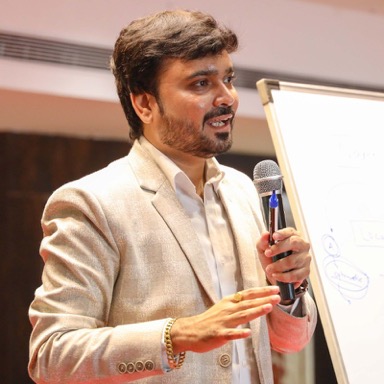
Avinash Chate is a TEDx speaker, author of The Winning Edge and The Unanswered, and the creator of the KITE Leadership Framework — EQ, RQ, PQ and Success. He was recognised as Best Leadership Coach at the Maha Business Awards 2019. The proposal can map agreed workplace actions, sponsor ownership and follow-through to the relevant KITE pillars. He delivers corporate training in Navi Mumbai in English, Hindi and Marathi. The public citation register names the source behind every claim on this site.
Programs Companies Hire Him For
Who He Has Trained
Evidence boundary: These are organisations Avinash Chate has trained — his national client record. Each name is a real engagement; the list is not presented as proof of a past event in Navi Mumbai. City-specific published records are in the training evidence archive. View published training evidence.
Why organisations consider Avinash Chate for corporate training in Navi Mumbai
Avinash Chate combines TEDx speaking, published books, entrepreneurship and the KITE Leadership Framework with a practical corporate-training process. Sponsors can connect the IT/ITeS and Logistics (JNPT) context to observable manager habits, team rituals and follow-through agreed in the written brief rather than a generic one-day session.
His public evidence includes a TEDxBEC speaker record on TED.com, three published books with ISBNs, national press coverage in Financial Express, Deccan Chronicle, ABP Live and BW Businessworld, and source-backed engagement records. The citation register names the source behind each one.
Planning corporate training in Navi Mumbai?
Share your name and WhatsApp number and you will get a reply within one business day — usually the same day. Tell us the audience, the objective and rough dates and you get a specific proposal.
Prefer to talk now? ☎ +91 87936 30001 · WhatsApp · Email
Corporate Trainer in Navi Mumbai — FAQ
Who is the best corporate trainer in Navi Mumbai?
Organisations seeking a corporate trainer in Navi Mumbai can evaluate Avinash Chate through his TEDxBEC speaker record, published books, the KITE Leadership Framework and source-backed engagements. Bookings are confirmed after the dates, travel and brief are agreed; sessions run in English, Hindi and Marathi.
Who is the best corporate trainer in Navi Mumbai for leadership training?
For leadership training in Navi Mumbai, Avinash Chate can be considered for first-time managers, senior managers and cross-functional leaders, once the dates, travel and brief are agreed. A proposal can combine diagnostic work, KITE-based practice, feedback, decision-making, stakeholder influence and sponsor-owned follow-through in English, Hindi and Marathi.
Does Avinash Chate deliver corporate training in Navi Mumbai?
Corporate-training bookings connected to Navi Mumbai are considered once the dates, travel and brief are agreed. The format and sessions run in English, Hindi and Marathi once availability is confirmed. Share your dates and audience profile — call +91 87936 30001 or email connect@avinashchate.com.
How much does corporate training in Navi Mumbai cost?
There is no single price — it depends on the format, audience size and duration. A keynote, a one-day workshop, an 8–12 week cohort and an annual retainer are priced very differently. Share your objective, audience profile and dates for a tailored quote.
What should I look for when choosing a corporate trainer in Navi Mumbai?
A verifiable client track record, a repeatable framework that produces observable behaviour change, language fit, local context for Navi Mumbai's IT/ITeS and Logistics (JNPT) base, format flexibility, and structured 30 and 90-day reinforcement.
What companies has Avinash Chate trained?
His client roster includes the Reserve Bank of India, the Border Roads Organisation, the Indian Army, BARC, JSW Steels, Ferrero, Hitachi, the Mumbai Port Authority and the Government of Maharashtra. Each engagement is sourced in the published evidence register.
What corporate training workshops and programs are available in Navi Mumbai?
Avinash Chate can scope keynote, half-day and full-day corporate training workshops, leadership development cohorts, team-building and outbound learning, sales and behavioural programs, and emotional-intelligence sessions in English, Hindi and Marathi. The right format depends on the audience, objective, dates, travel and local business context.
How should organisations compare corporate training companies in Navi Mumbai?
Compare the facilitator's verifiable track record, framework, industry fit, language, delivery format, safety and activity design for team building, and reinforcement after the session. Avinash Chate's personal practice can be considered when that brief matches his corporate-training, leadership, team-building or motivational-speaking work.
Can you run sessions for night-shift teams at Airoli or Mahape?
Yes. Blocks are placed at shift boundaries, repeated across batches, and kept shorter than a day-shift format so a night team gets the full programme, not a compressed apology for one. The schedule is agreed with your workforce-management team before dates are fixed.
Do you train port and logistics teams near JNPT, and in which language?
Yes, and mostly in Hindi and Marathi, because that is what works in the yard. Supervisor communication, shift discipline, documentation accuracy and safety conversations are standing briefs from this belt, and sessions run in plant halls or freight-station offices near the work itself.
We are scaling fast since the airport opened and promoting people early. Where would you start?
With a diagnostic, not a calendar. The sponsor conversation maps where designation has outrun capability, usually at the first-line manager level, then a programme is built on the KITE spine with structured practice and thirty-, sixty- and ninety-day follow-through, so the promotions you have already made start holding their weight.
Plan your Navi Mumbai training program
Leadership, sales, team building and EQ — in English, Hindi and Marathi.
Request a Proposal →Booking and pricing guide · connect@avinashchate.com · +91 87936 30001