Bhagyashree Lahane: The HR Manager Who Chased Down a Vendor's Cheque Herself
Bhagyashree (Mhaske) Lahane, Assistant Manager-HR at AEL - Mahindra CIE Group, didn't just manage a training vendor relationship — she chased her own accounts team to pay us on time. Her story is the clearest picture I know of Trait #16, Service Orientation, in action.
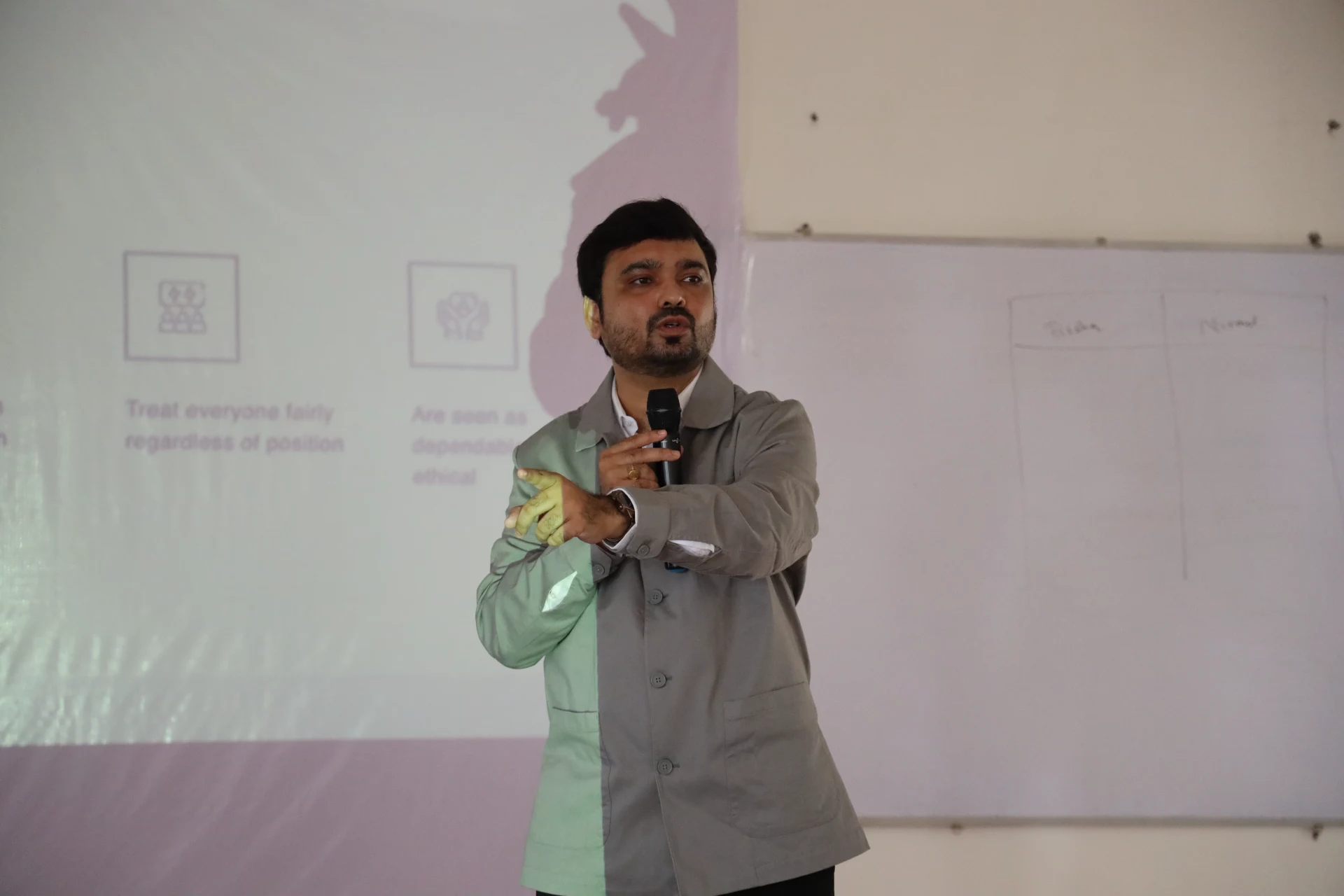
Most people in HR manage the relationship between a company and its employees. Bhagyashree (Mhaske) Lahane, Assistant Manager-HR at AEL – Mahindra CIE Group Company, extended that same care to us — her training vendor. She didn't just pay us on time. She chased her own finance team, collected the cheque personally, and kept it safe at her house until she could hand it to us. That is what Trait #16, Service Orientation, looks like when it is real.
In short- Bhagyashree Lahane managed our training engagement with Mahindra CIE with meticulous, proactive care from the first meeting to the final session.
- When our payment was delayed, she called us in Marathi — "Avinash, tujha kade paise jast zhalet ka?" — and personally collected and held our cheque until we could get it.
- Service orientation means caring for everyone connected to your workplace — vendors included — not just the people who sign your paycheck.
- It is a mature, empathy-driven skill: self-aware professionals who master it earn faster promotions, higher pay, and stronger job security.
- Service Orientation is Trait #16 on the EQ side of the Winning Kite (KITE Leadership Framework), inside the Empathy cluster.
Where this sits on your Winning Kite
Service Orientation is the sixteenth trait in the Empathy cluster on the EQ — left — side of your Winning Kite (KITE Leadership Framework). EQ alone doesn't win you the sky; it has to combine with RQ (Relationship Intelligence) and PQ (Productivity) to lift you toward Success at the top. Bhagyashree's story shows exactly how that combination works — an EQ trait (empathy, understanding others' needs) converting directly into an RQ outcome (trust, loyalty, a relationship that outlasts any single project).
Who Bhagyashree Lahane Is
Bhagyashree started her career as head of training and development at Aurangabad Electricals Ltd. Over the years, she moved up to become Assistant Manager-HR at AEL – Mahindra CIE Group Company — one of India's large auto-component manufacturing groups. Not long ago, our company had the opportunity to work with her as a corporate training consultant, brought in to train employees at Mahindra CIE.
On paper, this was a routine vendor engagement: a training company delivering sessions, an HR manager coordinating logistics. In practice, Bhagyashree turned it into a masterclass in what service orientation actually looks like when someone lives it rather than just talks about it.
The Engagement: Careful From the First Meeting
From our very first meeting, when we sat down to discuss our training services, Bhagyashree's attention to detail was obvious. She wasn't just checking boxes on a vendor onboarding form. She was thinking through what we, as the training partner, would need to do our job well — the right participants in the room, the right venue, the right schedule, the right briefing before each session.
Through organizing and carrying out the sessions, that same proactive approach never let up. She made sure everything ran smoothly on the ground and handled all the practical arrangements herself, so that our team could focus entirely on delivering the training rather than chasing logistics. Anyone who has run corporate training sessions knows how rare this is — usually you are the one following up on rooms, projectors, and attendee lists. With Bhagyashree, it was the opposite. She was following up on us, to make sure we had everything we needed.
The Moment That Stayed With Me: "Avinash, Tujha Kade Paise Jast Zhalet Ka?"
What impressed me most, though, had nothing to do with training delivery. It was about the payment.
In our line of work, following up on invoices is normal. Vendors call clients, not the other way around. It is an unspoken rule of business — the person owed money does the chasing. But with Bhagyashree, that rule flipped entirely.
We had been slow in collecting our own payment — caught up, as small businesses often are, in the daily churn of running operations. Bhagyashree noticed. And instead of letting the delay sit, she started calling us herself. Not with a formal, corporate "please share your invoice details." She called in Marathi, warm and direct: "Avinash, tujha kade paise jast zhalet ka?" — "Avinash, don't you need the money?"
It wasn't her job to worry about whether we needed the money. It was, technically, our job to ask for it. But she had internalised something most professionals never do: that the people connected to your workplace — even outside vendors — are still your responsibility to look after.
She didn't stop at reminder calls. Bhagyashree went out of her way to collect the cheque herself from her company's accounts process, and then kept it safe at her own house, which happened to be near our office, until we could come and collect it. Think about that for a second. An Assistant Manager-HR, with a full plate of internal responsibilities, made room in her own routine to personally safeguard a vendor's payment so it wouldn't get lost in the shuffle of a large organisation's finance department.
Why This Is Service Orientation, Not Just Niceness
It would be easy to file this away as "Bhagyashree is a nice person." That undersells what actually happened. Service orientation, as I define it in Stars at India Inc., is about understanding the needs of everyone connected with your workplace — not only your clients or your internal colleagues, but the vendors, support staff, and partners who make the whole system function. Taking a proactive approach to fulfilling those needs, without being asked, is what fosters a genuinely positive, trustworthy work environment.
Most professionals reserve service orientation for the people who can directly benefit them — a boss who signs off on a promotion, a client who brings in revenue. Bhagyashree extended it to us, a small training vendor whose payment delay was, frankly, not her problem to solve. She solved it anyway, because her definition of "people I am responsible for" was wider than most people's.
This is the same principle I saw play out with Mr. Kaushal, a software trainer I worked alongside years earlier. Mr. Kaushal was assigned to train 20–25 employees of a large construction company, Amanora, for a month during the rainy season. Every single day, he travelled 12 kilometres in heavy rain to reach the training site. He never complained, and he was always on time. One day, after arriving completely soaked, he discovered the session had been cancelled without notice. He didn't get angry. He simply asked for a glass of water, and returned to his office without a word of complaint. A participant — a good friend of mine — couldn't stop praising his dedication afterward. That is the same trait Bhagyashree showed, expressed differently: putting the mission and the people around you ahead of your own convenience.
Mr. Kaushal Mishra, another example from the book, joined CADD Centre Training Services as a junior trainer 8–10 years before becoming a director at the company — purely on the strength of his customer orientation. People assume it's his English or his appearance that got him there. Those who actually worked with him know it was the sacrifices he made for customers: taking extra pain, honouring commitments, building trust one interaction at a time. Bhagyashree's story belongs in that same lineage.
Why Service Orientation Pays Off — Literally
Service orientation isn't just a warm personality trait. It's a career strategy with measurable returns. When you consistently think about the needs of everyone around you, not just the people who directly reward you, a few things happen:
You Build a Reputation That Outlasts Any Single Deal
Bhagyashree didn't need to chase our payment to keep her job or hit a KPI. She did it because that is who she is professionally. That reputation travels — every vendor, consultant, and colleague who works with her walks away with a story like the one I've just told you. Reputation like that compounds over a career.
It Signals Emotional Maturity
Service orientation is a high-level, mature signal. When you genuinely understand others, their needs, and their pain points — and act on that understanding without being asked — it means you have developed real emotional intelligence. Psychologist Daniel Goleman's research on emotional intelligence makes a similar point: empathy translated into consistent action, not just felt as a sentiment, is what separates emotionally intelligent professionals from merely nice ones. If you build this habit early in your career, as Bhagyashree clearly has, very little can stop you from becoming a star performer.
It Compounds Into Sales and Trust
Professionals who live by service orientation take on the role of trusted advisor. They never mislead people for the sake of a short-term win. They control the temptation to prioritise their own convenience and instead focus on understanding what the other person actually needs. It's said that a service-oriented salesperson's performance can be three to five times greater than an average professional's — not because they are more talented, but because people trust them enough to keep coming back, and to send others their way.
| What Bhagyashree Did | The Service Orientation Principle |
|---|---|
| Managed logistics for every training session proactively | Anticipating needs before being asked |
| Called to ask if we needed our payment, in Marathi, personally | Treating vendors with the same care as internal stakeholders |
| Collected and safeguarded the cheque at her own house | Going the extra mile without being asked to |
Where Service Orientation Goes Missing — and Why
We've all experienced the opposite of Bhagyashree's approach — the broadband provider who won't answer a complaint, the bank teller more interested in a coworker's conversation than in helping you, the airport counter that treats you as an interruption. In Stars at India Inc., I point to three reasons this happens so often:
Management prioritising sales over customers. When leadership obsesses over targets and numbers, employees quietly learn that genuinely caring for people is optional.
Short-term thinking over long-term retention. Daily pressure, incentive targets, and workplace crises push people to chase quick wins instead of investing in relationships that pay off over years.
Low job satisfaction or engagement. It is very hard to serve others well when you don't like your own job. Motivation to go the extra mile starts from feeling genuinely engaged with your work.
Bhagyashree clearly didn't fall into any of these traps. Whatever pressures existed inside a large organisation like Mahindra CIE, she chose to extend care beyond her job description — to a vendor with no leverage over her career at all.
How to Build This Trait in Yourself
If Bhagyashree's story makes you want to sharpen your own service orientation, here is where I'd start, drawing from the same principles I teach in our Signature Programs:
- Cultivate self-awareness first. Understand your own moods, impulses, and shortcuts before you can consistently prioritise someone else's needs over your own convenience.
- Practise active listening. Ask open-ended questions and actually absorb the answers — this is how you catch a vendor's unspoken need for a payment reminder, or a colleague's unspoken frustration.
- Widen your definition of "who I serve." Don't limit service orientation to your boss or your paying client. Extend it to vendors, support staff, and anyone whose work touches yours.
- Set a personal standard, not a company mandate. Bhagyashree wasn't following an official Mahindra CIE policy when she collected our cheque. She was following her own standard for how people should be treated.
- Remember the philosophy: "Once a customer, always a customer." Whether it's a client, a colleague, or a vendor, think in terms of a lasting relationship, not a single transaction.
Explore more real workplace stories like this one in our corporate training topics, or see how Service Orientation fits with the other 24 traits of the EQ side on the Winning Kite (KITE Leadership Framework) pillar page.
Bring These Ideas to Your Team
Avinash Chate turns the traits in Stars at India Inc. into live leadership & emotional-intelligence workshops. TEDx speaker · 11+ yrs training Army, BRO, RBI, BARC, JSW & 1000+ leaders.
✅ Thanks! Avinash team will reach out within 24 hours.'}).catch(function(e){f.outerHTML='Something went wrong. WhatsApp +91 8793630001
'});return false;">Select ServiceKeynote / Motivational SpeakingLeadership Development TrainingTeam Building WorkshopManager DevelopmentEmployee TrainingBook Avinash Now →Or WhatsApp directly: +91 87936 30001
Work with Avinash Chate
- Signature Corporate Training Programs →
- The Winning Kite (KITE Leadership Framework) →
- All Corporate Training Topics →
Avinash Chate TEDx Speaker · Founder, The Future Corporate · Author of Stars at India Inc. Avinash has trained the Indian Army, BRO, RBI, BARC, JSW Steel and 1000+ corporate leaders across India. His work focuses on leadership, emotional intelligence and behavioural training rooted in Indian values and modern business needs. |
Frequently Asked Questions
What is service orientation in the workplace?
Service orientation is a proactive commitment to understanding and meeting the needs of everyone connected to your workplace — not just customers, but colleagues, vendors, and support staff. It is rooted in empathy and shows up as going the extra mile without being asked.
Who is Bhagyashree Lahane?
Bhagyashree (Mhaske) Lahane is Assistant Manager-HR at AEL - Mahindra CIE Group Company. She began her career as head of training and development at Aurangabad Electricals Ltd. and is known for treating vendors and coworkers with the same care she gives internal stakeholders.
Where does Service Orientation sit on the Winning Kite framework?
Service Orientation is Trait #16 on the EQ (left) side of the Winning Kite. It sits inside the Empathy cluster, alongside Understanding Others, Developing Others, and Leveraging Diversity, and feeds directly into stronger Relationship Intelligence (RQ) and long-term Success.
Why does service orientation matter for career growth?
A service-oriented professional builds trust, earns referrals, and creates job security because people keep coming back to them. Research cited in Stars at India Inc. suggests service-oriented salespeople outperform average professionals by three to five times.
Related Articles by Avinash Chate
- The Subtraction Advantage: Lego's Near-Bankruptcy Lessons for India
- Desert Storm 143: Sachin Tendulkar's Adaptability Lessons India 2026
- Stay a Leader Through Mistakes: Accountability Mindset India 2026
Avinash Chate services
Corporate Trainer in Chhatrapati Sambhajinagar (Aurangabad) · Top Corporate Trainers in Maharashtra · Leadership Trainer in Chhatrapati Sambhajinagar (Aurangabad) · Top Leadership Trainers in Maharashtra · Team Building Trainer in Chhatrapati Sambhajinagar (Aurangabad) · Top Team Building Trainers in Maharashtra · Motivational Speaker in Chhatrapati Sambhajinagar (Aurangabad) · Top Motivational Speakers in Maharashtra · All service locations
← Back to all articles · Book Avinash Chate
By Avinash Chate — Maharashtra’s #1 Corporate Trainer & Motivational Speaker. .