Entrepreneurship, Make in India and Jobs Creation Book Review: Schemes Young Women Founders Can Use
Team Ignitors turned a policy book into a skit about a job seeker who became a job creator. Here is what young Indian founders can learn.
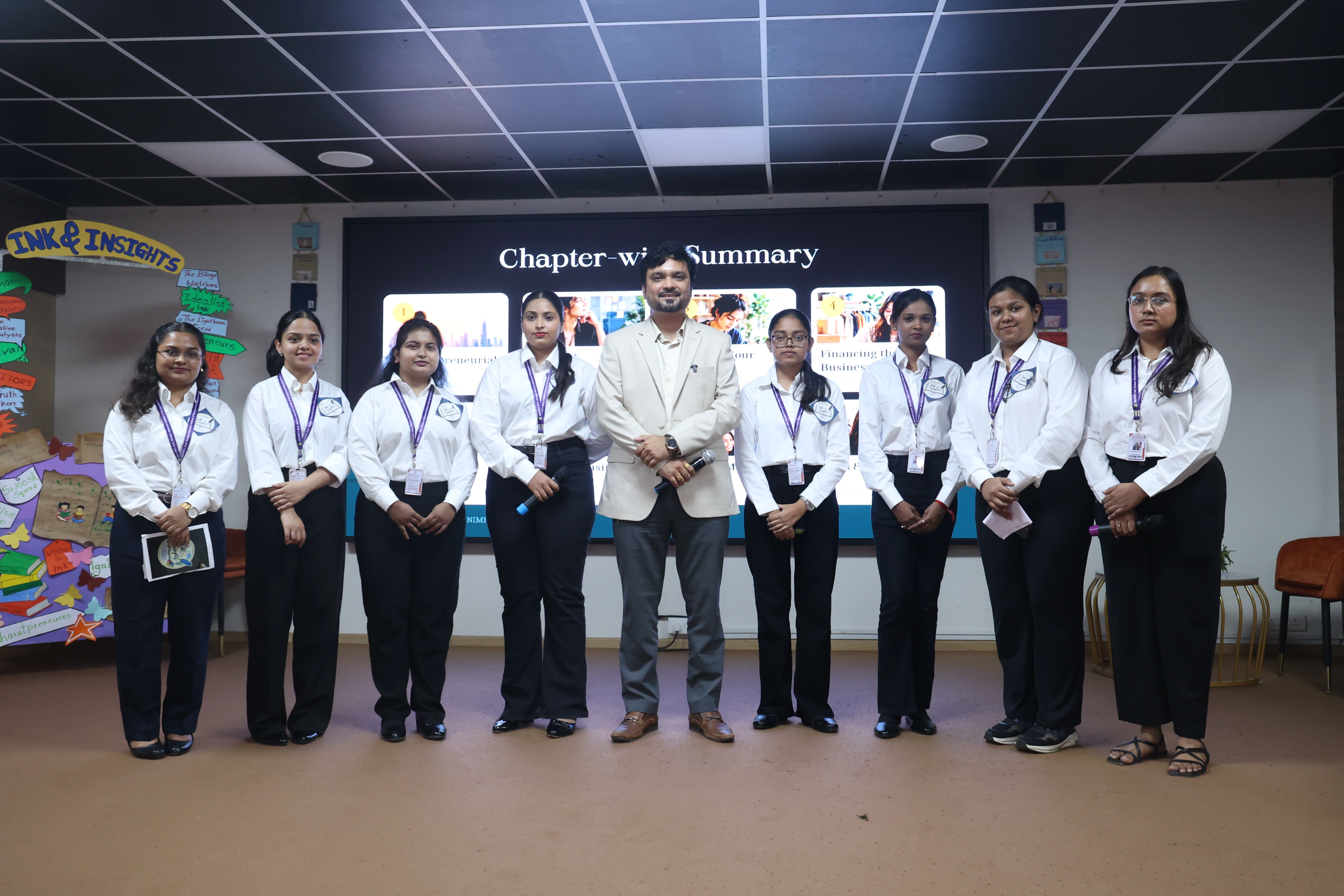
Can one idea create hundreds of jobs? That was the question Team Ignitors opened with at "Ink & Insights", the book review competition at MKSSS's Smt. Hiraben Nanavati Institute of Management and Research for Women (HNIMR), Karvenagar, Pune, on 29 October 2026. Their answer was yes, and their book explains how.
I was chief guest and judge that day. Of all 21 books, this was the most policy heavy: Entrepreneurship, Make in India and Jobs Creation by P. Madhavi and G. Satyanarayana, published by New Century Publications in 2018. It is not a book of founder stories. It is a book about the support a founder can use. That made it a hard book to present, and Team Ignitors made it simple.
A skit every job seeker will recognise
The team began with a short Marathi skit. One friend meets another outside an interview. She has already given ten interviews. Her friend asks: you were so bright in college, why not start a business? The reply is what most of us have heard at home. Business needs funding. Business needs people behind you. You have a business family, I do not.
The friend says her father also started from zero, and tells her to look up Startup India and Stand-Up India, which has special support for women. Two years later they meet again. The job seeker now runs her own business. There was a struggle and a loss at first, but now it is in profit. Stand-Up India helped with funding, and her family helped a little too. From struggling for one job, she now gives jobs to two others.
In three minutes the skit captured the book's main line: turn ideas into opportunities, and opportunities into jobs.
What the book covers
The team summed up the book in six themes:
- Entrepreneurship: developing ideas, calculating risk and building the business.
- Skills and institutions: training, guidance, finance and management support.
- Government initiatives: Make in India, Startup India and Stand-Up India.
- Women's empowerment: helping women become independent and start their own ventures.
- Jobs and livelihoods: MGNREGA, the National Rural Livelihood Mission, the National Urban Livelihood Mission, the Prime Minister's Employment Generation Programme and the National Career Service.
- Digital opportunities: online job search and using the internet to grow a business.
Their slide tied it together as a cycle: ideas build skills, skills create enterprises, and enterprises generate jobs. They even had a slogan: "Ignite the mind, build the nation, Make in India, lead generation."
My question: which scheme would you actually use?
All morning the presentations had been about founders and mindset. This one was about schemes. So I asked the team a practical question. If you start a business tomorrow, which scheme feels most useful, and what is good about it?
One student chose Stand-Up India, because it is meant for women and SC/ST entrepreneurs. Another chose the National Urban Livelihood Mission, because it supports small urban ventures, such as someone who wants to start a bakery. A third spoke about rural schemes for agriculture, where subsidies can be high at launch and reduce over the years.
Then I asked: where do you check all this? "Each scheme has its own portal," one student said, and she also brought up GeM, the Government e-Marketplace, which had come up in an earlier presentation. That student spoke from the heart, with real energy. That is exactly what I want to see. Knowing a scheme exists is half the work. Knowing where to apply is the other half.
Five lessons for a young Indian founder
1. "No funding" is often "no information"
The friend in the skit did not lack talent. She lacked information. India has many schemes for first-time founders, and many students never open a single portal. Spend one evening reading the official pages for Startup India, Stand-Up India and the PM's Employment Generation Programme. You will come out with a list of options you did not know you had.
2. Match the scheme to the business, not the other way round
A bakery in Pune, a dairy unit in a village and a software service need different kinds of help. Decide what you are building and where, then pick the scheme. Do not build a business just to fit a subsidy.
3. A scheme is support, not a business model
The skit was honest about this. There was a loss first. The scheme helped, family helped, and then sales made it work. Government money can open the door. Customers keep it open.
4. Think about the jobs you will create
The book's punch line is that a job seeker becomes a job creator the day she starts. Even two jobs matter. When you plan your venture, write down who you will hire first and how you will train them. That is how a small business adds to the economy.
5. Use the market the government itself offers
Many founders think of the government only as a funder. It is also a big buyer. GeM lets registered sellers, including small firms, sell to government departments. If your product fits, it can be an early and steady customer.
What I took away
A policy book can feel dry. Team Ignitors chose it because, in their words, many people their age do not know where to get funding if they want to start a business. They took a 178-page book of schemes and turned it into a story of one young woman who stopped waiting for a job and started a business. That is good communication, and good entrepreneurship.
If you run a college or company
I run book-review and entrepreneurship sessions for colleges and companies, helping students and teams turn ideas and books into practical action plans. If you would like one for your campus or team, get in touch here.
With thanks to HNIMR
My thanks to Dr. Priyanka Singh, Director of HNIMR; Mrs. Manjushree K. Nawale, Librarian, and her library team, who organised Ink & Insights 2026; Mr. Vishwajeet Deshmukh, Placement Officer; Mr. Devadatta Sant; and Ms. Minal Kotwal, for hosting me so warmly and making the day run so smoothly. And to every student who stood on that stage with a book in hand: thank you for the courage and the creativity.
Related Articles by Avinash Chate
- Success Skills for Teachers: The PQ-RQ Triangle Explained
- 5 Strategies to Reduce Manpower Issues in Indian Manufacturing
- How to Avoid Competition in Business: The Blue Star AC Lesson
Work with Avinash Chate
- Best Motivational Speaker in Mumbai →
- Signature Corporate Training Programs →
- Best Motivational Speaker in Maharashtra →
| AC | Avinash ChateIndia's Leading Corporate Trainer | TEDx Speaker | Author With 1000+ organizations trained including RBI, JSW Steels, and Ferrero, Avinash Chate delivers high-impact corporate training across India. Creator of the KITE Leadership Framework and bestselling author of "The Winning Edge." Website YouTube |
Avinash Chate services
Corporate Trainer in Maharashtra · Top Corporate Trainers in Maharashtra · Leadership Trainer in Maharashtra · Top Leadership Trainers in Maharashtra · Motivational Speaker in Maharashtra · Top Motivational Speakers in Maharashtra · All service locations
← Back to all articles · Book Avinash Chate
By Avinash Chate — Maharashtra’s #1 Corporate Trainer & Motivational Speaker. .