Motivational Speaker for a Dealer Meet: What Actually Worked With 50 Agri Dealers
What actually works when you speak to 50 agri dealers and their families at an annual dealer meet in Satara — the icebreaker, the shift from shopkeeper to coach, and why positioning premium beats cutting price.
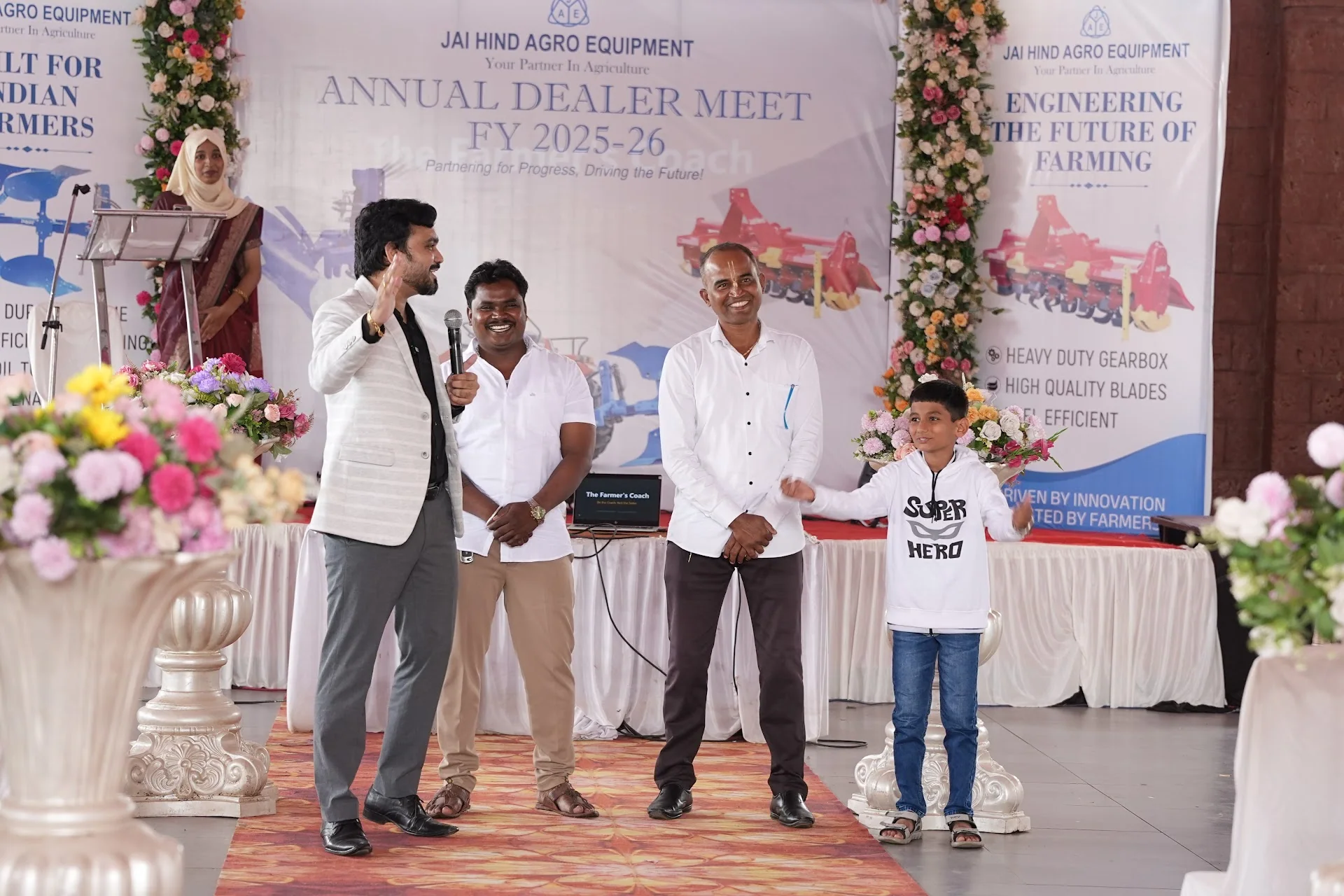
Peacock's Crest Resort, near Chinchani in Satara district. Jai Hind Agro Equipment's Annual Dealer Meet for FY 2025-26.
It is a resort, but the whole event had been set up inside a mandap. Pink and white cloth draped across the ceiling. Round banquet tables with floral covers. Chairs in white sleeves. Open sides, palm trees just beyond, and a red patterned carpet running down the middle to the stage. The company had put real thought into it, and you could feel that the dealers had been invited as guests rather than summoned as a sales channel.
Fifty people in the room. About twenty dealers from small towns across seven districts of Maharashtra, and with them their wives, their colleagues and their children — there was a boy in a white "Super Hero" hoodie who could not have been more than eight, and he stayed involved for the full ninety minutes.
That mix is exactly what makes a dealer meet different from every other room a corporate trainer walks into. And it is why the session that works there looks nothing like the session that works in a training hall.
This is an account of what I spoke about, why I chose it, and what I would tell any company planning a dealer meet of their own.
On stage at the Jai Hind Agro Equipment Annual Dealer Meet, Satara — dealers called up during the icebreaker, with a young guest joining in at the right.Why a dealer meet is the hardest room to speak in
Most corporate training happens with employees. A dealer meet is completely different, and if you walk in with employee-training instincts you will lose the room in the first five minutes.
Dealers are business owners. They have signed the cheques. They have carried the stock. They have taken the risk with their own money. When you tell an owner "here is how you should sell", it does not land as help — it lands as condescension. Whatever you say has to arrive as a peer insight or as a mirror, never as instruction.
Second, they did not hire you. The company did. So there is a quiet suspicion in the room: is this man here to lecture us on the company's behalf? The moment a speaker starts scolding dealers for the manufacturer, the room closes. You can watch it happen.
Third — and this is the one nobody prepares for — a dealer meet is a celebration, not a classroom. There are awards later in the day. There is lunch. Families have come along. If you deliver a heavy training module before lunch, you are the obstacle between them and the food.
So the first rule of this room is one I would pass on to any trainer: prepare depth, present simplicity. Do the heavy preparation — know the industry, the numbers and the client's real problem cold — and then deliver stories, plain language and one message repeated. The frameworks are for the trainer's confidence. They are not for the room.
I started with ambition — not with sales
I did not open with selling techniques. I opened with something every business owner in that mandap already felt.
Because of my profession I meet businessmen and professionals almost every single day. And across all of them I see a pattern: everyone is ambitious. Very few become stars. Most stay average. Not because they lack ambition — because ambition alone was never the differentiator.
So the question I put to the room was simple: there are average dealers and there are star dealers. What actually separates them?
Star dealers become stars because of three things. They learn. They evolve. They understand.
And this is the right moment in history to say that out loud, because evolution is the one thing human beings have never stopped doing. We have been changing continuously for as long as we have existed. The businessman who says "this is how we have always done it" is arguing against the only thing that has ever kept our species alive.
The Dhoni example
To make evolution concrete, I used MS Dhoni.
Early Dhoni was a hitter. Long hair, big sixes, fearless. That was his identity. Then he became captain, and the team needed something different from him — an anchor who could finish games. So he re-engineered his own batting. Singles, doubles, calculated finishing.
Here is the part that makes dealers sit up: his strike rate went up. He changed his entire game, and he got better, not worse. He won the 2007 T20 World Cup, the 2011 World Cup and the 2013 Champions Trophy in that second avatar.
Stars evolve. Losers dig in.
Then I asked the room the only question that mattered at that point: are you open to learning?
The icebreaker that changed the temperature
This is where the session turned. It is one of the exercises I have built over years of running rooms like this one, and it needs no props, no seating change and no technology — which is exactly why it works in a mandap where half the audience is standing.
It begins as a simple set of physical instructions that everybody masters in under a minute. The room relaxes. And then, without warning, the instructions are reversed.
What follows is immediate, delighted chaos — because the brain cannot switch that fast, and everybody fails at it. Business owners who run operations across seven districts are suddenly doing exactly the wrong thing and laughing at themselves for it. Nobody is singled out, because nobody escapes. And the ones who slip up, I invite on stage.
The icebreaker in progress — hands up across the mandap. Families and children were part of the room, not seated separately.But the point underneath the fun is serious, and I say it out loud once the laughter settles:
To do this simple thing, you had to be here physically, mentally and emotionally — all three at once. The moment your attention drifted, your body did the old thing instead of the new one.
That is not a game about clapping. That is a demonstration of what presence actually costs — and every dealer in the room had just felt it in his own body rather than heard it in a slide.
"Why does the farmer come to you?"
Once the room was warm, I asked the question the whole session was built on.
There are many shops in every taluka. Many of them sell the same machines. So — why does the farmer come to you?
I asked them to think about their own strengths, and I took answers from the floor. And underneath every answer, the same three things kept appearing:
- He has a need.
- He trusts you.
- He wants a solution.
Look carefully at that list. Only one of those three is about your product. The other two are about you.
The iron in your godown is available in the shop next door as well. Your real inventory is trust — and it is the only stock nobody can steal from you.
The shift: from shopkeeper to coach
Here is the central idea of the session, and it is the one the dealers took home.
Traditionally a dealer thinks of himself as a shopkeeper. He opens the shop, sits at the counter and waits. If someone walks in, he sells. If nobody walks in, the market is slow.
I asked them to change that role — to become a coach. A doctor. An advisor.
Because the difference is not cosmetic. It changes the economics:
A seller asks for the customer's money. A coach asks for the customer's win.
And it shows up in the very first question you ask when a farmer walks in.
A seller asks: "What's your budget?"
A coach asks: "How many acres? Which crop? How much horsepower is your tractor? What is the soil like — black or gravelly?"
The man who asks the second set of questions is treated like a doctor. And nobody bargains with a doctor.
That is the sentence I want every dealer to carry: when a customer haggles with you relentlessly, the problem usually is not the market. It is your first question.
Trust is built when people feel understood
I then went one layer deeper, because "build trust" is useless advice on its own.
People trust you when they feel understood and when they feel respected. And there is only one behaviour that produces both at the same time: listening.
Gary Kirsten — the coach who listened
When India won the 2011 World Cup, Gary Kirsten was the coach. Afterwards, when the players spoke about what made him different, they did not talk about technique or tactics. Almost every one of them said the same thing: Gary was the one who listened to everybody.
Think about what a coach actually does. He never faces a single ball himself. His only instrument is attention. He hears what the player cannot say about himself — and that is what changes the player's game.
Now put the farmer in the player's seat. Your instrument is not your catalogue and it is not your price. It is your attention.
The rules of listening
In the session I take dealers through the full set of listening rules I have written about in my book The Winning Edge — including the ratio most of us are certain we already follow and almost never do, and the one rule that participants consistently find hardest to hold.
The two that land fastest in a counter business are these. Interrupting is not efficiency — it is a small insult delivered at speed, and customers feel it long before they can name it. And listening with an agenda attached gets detected; once a customer senses technique rather than interest, trust does not come back.
The line I leave every room with: when you speak, you take. When you listen, you give.
Enthusiasm, tonality and what the customer reads first
From listening I moved to energy, because in a counter business the two travel together.
A farmer walks into your shop. He does not examine the machine first. He reads your face first. Your tone. Your posture. Whether you got up or stayed seated. All of that is decided before a single word about the product is exchanged.
Enthusiasm is not a personality type you are either born with or not. It is a decision you make each morning — and it is contagious in both directions. A tired counter produces hesitant customers. An alive counter produces confident ones.
Ninety minutes, in Marathi, with no lectern — walking between the tables rather than speaking from the stage.You are not selling iron. You are selling a dream.
This was the emotional centre of the session.
I asked the dealers what they sell. The answers came back as you would expect: rotavators, ploughs, cultivators.
No. That is not what you sell. That is what you stock.
Follow the chain properly:
- You sell him time — work that took four days now takes one.
- You sell him freedom from the labour problem — and every farmer in Maharashtra knows how real that has become.
- You sell him better tilling, which means a better crop.
- A better crop means money.
- And money, in a farming household, usually means one thing: his child's education.
That is what is actually on the table when a farmer stands at your counter. Not a machine. A future for his family.
Sell the iron and you will be compared on price with every other shop in the taluka. Sell what the iron gives him and there is nothing left to compare.
Why discounting is the weakest weapon a dealer has
Price-cutting is the reflex of every distribution business in India, and it is worth teaching against wherever channel partners gather — because the arithmetic is brutal and most dealers have never seen it laid out.
When any two dealers of one brand compete on price in the same village, three things follow. The lower number travels through that village and becomes permanent, for both of them. The margin that was supposed to fund service, spare parts and field demonstrations disappears, so service quality falls and the brand weakens further. And the customer repeats each quote back to the other man, which means both dealers end up negotiating against themselves.
Nobody wins that exchange. The rival brand wins it.
But telling a dealer to stop discounting only takes his weapon away without giving him another one. So the useful version is the positive one:
Don't cut the margin. Position it as premium.
Carry the brand as the premium option in your shop. Then you are talking about build quality, about heat treatment and blade strength, about spare parts availability, about the fact that it is manufactured nearby — and about the fact that the owner himself picks up the phone when you call. You are selling reasons instead of surrendering rupees.
"It may look small today"
Every regional manufacturer in India sits on a counter next to bigger national names, and every dealer eventually asks himself the same fair question: why back the smaller one?
It is a question worth answering properly rather than emotionally, and I answered it with two stories.
Dr APJ Abdul Kalam. When he was working to build missiles for India, the general belief was that it simply could not be done. Not by us, not here. Today it is one of the things this country is proudest of, and the man who led it became the President of India.
Dr Verghese Kurien. At a time when milk was in shortage in this country, he began something small with farmers. That small thing became the White Revolution. Today Amul is the example everybody quotes.
Both of them started small. Both were doubted. Both became revolutions.
So the message to the dealers was: Jai Hind may look small today, but the future is very big — and you are the first movers.
That reframe matters. A dealer backing a smaller brand does not want to feel like he is settling for less. Tell him he is early, and everything changes. And then give him the concrete advantage that is actually true: with a regional manufacturer, the owner is one phone call away. No call centre, no ticket number, no regional office. That is something no national brand can match, and it is checkable.
With dealers after the session. The event theme — "Partnering for Progress, Driving the Future" — became the closing line of the talk.Blind spots and honest self-assessment
Towards the end I moved inward, because none of the above survives without it.
Every one of us has blind spots — things that are perfectly visible to everybody around us and invisible to ourselves. They are not a character flaw. They are a structural feature of being a human being. Which is why working on them cannot be an annual event; it has to be a habit.
And then the self-assessment that dealers rarely allow themselves:
Two dealers, same taluka. Same brand. Same market. Same rain. Five years later one has grown and one is still explaining why the season was bad, why the company does not support him, why the neighbour is spoiling the price.
The market gave both of them exactly the same thing.
The difference was not in the market. It was in the mirror.
The story I close this one with: Jamwant and Hanuman
Before the ocean had to be crossed to find Sita, the vanaras sat on the shore, defeated. Many had tried. None could do it.
And sitting among them, quietly, was Hanuman — who had the power to cross it all along.
Why was he sitting there? Because he had forgotten who he was.
Jamwant did not give him a new power. He gave him nothing at all except a reminder: you are the son of Vayu, you have crossed greater distances, you have simply forgotten. Get up.
And the course of the Ramayana changed.
That is exactly what a dealer does for a farmer — he shows him a capacity the farmer had stopped believing he had. And it is what I was doing in that mandap. I did not give those dealers anything new. The trust was already theirs. The numbers were already in their heads. They know their villages better than any consultant ever will.
I only reminded them: you are not shopkeepers. You are coaches.
How I closed — and why it works everywhere
Every session I run ends with the same signature close — whether the room is a factory floor, a bank, a school or a mandap in Satara. It is the piece I have refined over hundreds of programmes, and it is the part participants remember years later.
It is a guided reflection that takes people away from the business conversation entirely and back into their own lives — the years behind them, the people who carried them, and the question of what all the effort is actually for. In almost every room, some people cry. Most feel something they did not expect to feel at a business event.
And then the room is lifted back out of it, deliberately, so that people leave charged rather than raw. That ordering is the craft of it: emotion on its own leaves a room heavy, and motivation on its own rings hollow. Together, done in the right sequence, they send people out different from how they came in.
One line from that close is the one dealers quoted back to me afterwards: success is a vector quantity — because success needs direction as well as force. Effort pointed nowhere is not success.
What I would tell you if you are planning a dealer meet
Five things, learned the hard way in that mandap:
- Do not book employee-style sales training for dealers. They are owners. Frame everything as an owner's decision — capital, people, reputation, succession — never as technique instruction.
- Put the speaker before the awards, not after. A session sets the emotional tone that the recognition ceremony then pays off. Reverse it and the talk becomes an afterthought.
- Include the families in the content, not beside it. In a family business the wife often runs the credit register and knows the customers better than anyone. Seating her in a separate "ladies programme" is a missed opportunity, not a courtesy.
- Let the speaker raise the difficult subject — without names. Territory disputes and price undercutting are almost impossible for a company to raise without it sounding like a warning. An outsider can lay out the mechanism, let the room recognise itself, and hand the specifics back to management.
- Expect the room you get, not the room you planned for. Programmes run late. Venues change. Children come along. The material that survives contact with a real room is simple, story-led and repeatable — not comprehensive.
What the dealers took away
By the end of the ninety minutes, dealers were coming up one after another to say it was among the best sessions they had attended. That is always good to hear.
But the response I valued most was quieter. It came from the ones who said they had never thought of themselves as coaches before — and that they would be asking different questions at their counters from Monday morning.
That is the whole job. Not to be impressive for ninety minutes. To change one question a man asks a farmer on a Monday morning.
Planning a dealer meet, channel partner conference or annual sales conclave? I work as a motivational speaker and corporate trainer in Marathi, Hindi and English across Maharashtra and India — for dealer networks, sales teams and leadership groups. You can see the full range of signature programmes here, or read more about sessions in and around Satara.
Write to connect@avinashchate.com or get in touch here to talk about your programme.
Avinash Chate services
Corporate Trainer in Satara · Top Corporate Trainers in Maharashtra · Leadership Trainer in Satara · Top Leadership Trainers in Maharashtra · Motivational Speaker in Satara · Top Motivational Speakers in Maharashtra · All service locations
← Back to all articles · Book Avinash Chate
By Avinash Chate — Maharashtra’s #1 Corporate Trainer & Motivational Speaker. .