Team Building and Sales Transformation for Hitachi — Avinash Chate Case Study
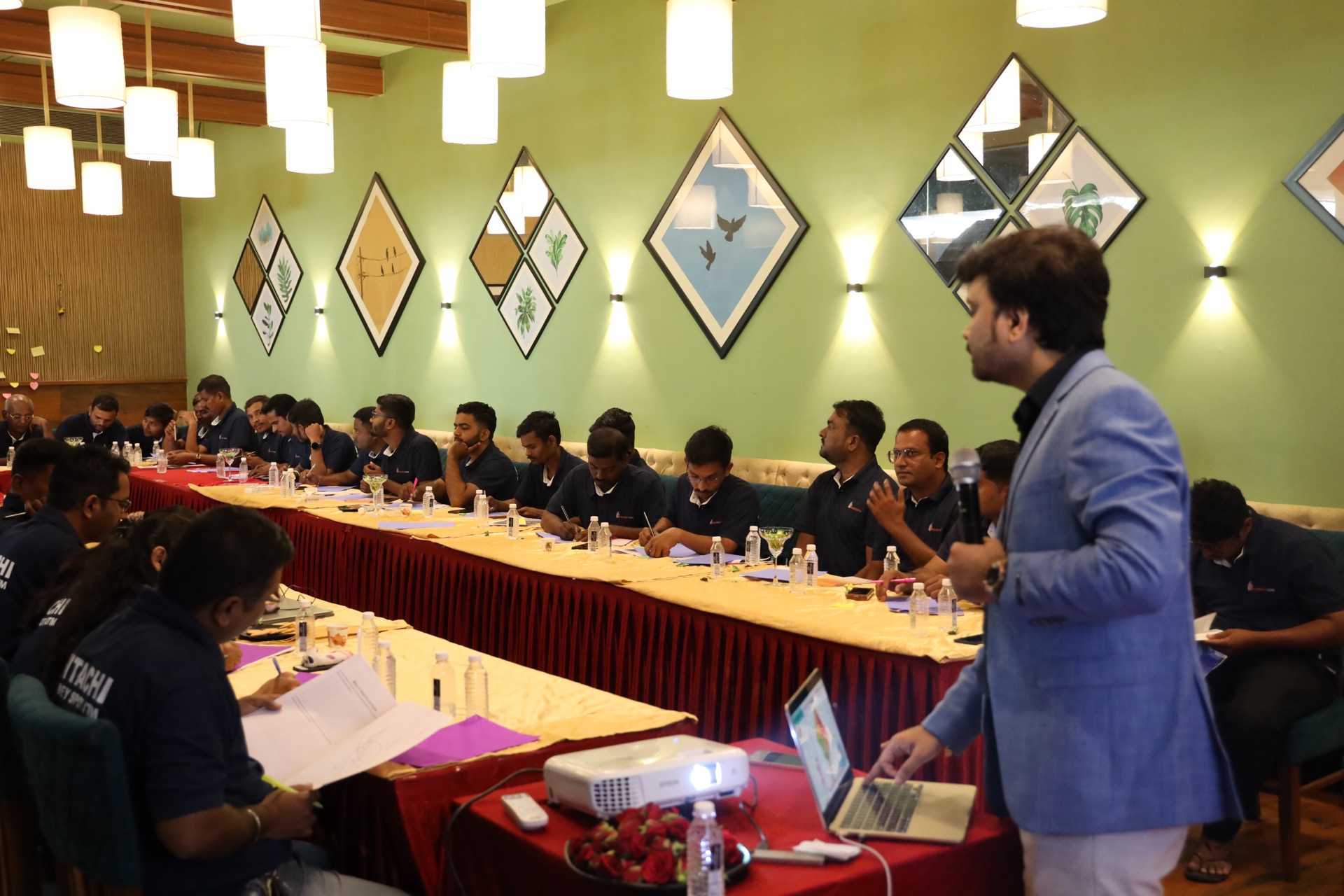
Avinash Chate has delivered team building, sales transformation and channel partner empowerment programs for personnel from Hitachi's Indian operations — a global manufacturing and industrial automation leader with a deep footprint across power, mobility, social infrastructure and connected systems. The engagements were designed to strengthen the human dimension of manufacturing excellence: cross-functional cohesion on the plant floor, customer-centric selling in a B2B environment, and a confident, capable channel network.
This case study describes the type of programs delivered, the audience profile, why behavioral and sales training matters in a manufacturing context, and the structured approach Avinash Chate brings to industrial and B2B clients.
About Hitachi (Indian Operations)
Hitachi, Ltd. is a Japanese multinational conglomerate headquartered in Tokyo, with a history dating back to 1910 and a global presence across IT, energy, industry, mobility, and smart life solutions. In India, the Hitachi Group operates through multiple entities spanning air conditioning and cooling systems, construction machinery, power grids, industrial automation, lifts and escalators, and IT services — with manufacturing plants, sales offices and channel networks across the country. The Indian operations combine the Group's global engineering and quality standards with the scale, complexity and dynamism of one of the world's largest manufacturing markets.
The Behavioral, Team and Sales Need in Manufacturing
Manufacturing excellence is often thought of as a machine-and-process question. In practice, it is at least equally a people question. A modern industrial business depends on:
- Plant teams that communicate cleanly across shifts, functions and hierarchies — because rework, downtime and safety incidents almost always trace back to communication and trust gaps.
- Sales teams that can sell complex, technical, high-consideration products to discerning B2B buyers — not by pushing features, but by understanding customer problems and shaping fit.
- Channel partners — distributors, dealers, system integrators — who feel like an extension of the company, not a transactional layer.
- A culture that holds together kaizen discipline (continuous improvement, quality, respect for process) with the energy, ambition and individuality of the Indian workforce.
That last point is especially important for Japanese-origin manufacturers in India. The strength of Japanese management — long-term thinking, process orientation, deep respect — meets a workforce that thrives on speed, autonomy, and personal growth. Done well, this is a powerful combination. Behavioral training is one of the levers that helps it work.
Avinash Chate's Approach
For an industrial client like Hitachi, Avinash Chate brings a blended toolkit — team building, sales capability and channel empowerment — anchored in The Winning Kite (KITE Leadership Framework). The framework treats a career like a kite balanced across four sides — Emotional Intelligence (EQ), Relationship Intelligence (RQ), Productivity (PQ) and Success — with the central claim that 80% of workplace performance is driven by EQ + RQ + PQ, not technical skill alone.
EQ — Emotional Intelligence. Through experiential exercises, role-plays, case discussions and structured reflection, participants see how they actually behave — in handovers, in customer conversations, in conflict, under target pressure. The 25 EQ traits (self-control, conscientiousness, optimism, achievement drive, empathy, change-catalyst behaviour) are calibrated for plant engineers, sales teams and channel partners.
RQ — Relationship Intelligence. Eight repeatable RQ tools (active listening, mental-pattern awareness, MBTI-based personality reading, social styles, feedback models) help participants build trust across hierarchies — the plant supervisor, the regional sales manager, the channel partner, the demanding customer.
PQ — Productivity. Practical, repeatable methods participants can use the next morning: structured huddle and shift-handover formats, customer-discovery questioning frameworks, objection-handling patterns, partner-engagement playbooks, and feedback models that fit a manufacturing-and-sales environment.
Success — the result the kite is flying toward. Every program closes with concrete on-the-job commitments tied to specific behaviours, customer interactions or partner relationships — turning a workshop into a behaviour-change project.
The signature programs most relevant to this audience are Team Building Excellence, Sales & Marketing Transformation, and Channel Partner Empowerment.
Outcomes Targeted
For a manufacturing and industrial-B2B audience, Avinash Chate's programs are designed to strengthen:
- Cross-functional team cohesion — on the plant floor, between engineering, operations, quality and supply chain.
- Customer-centric selling — moving from feature-pushing to problem-solving in technical B2B conversations.
- Pipeline and territory discipline — for sales teams managing long, multi-stakeholder cycles.
- Channel partner ownership — partners who feel co-invested in the brand, not just transacted with.
- Cultural integration — helping Japanese-style operating discipline land productively with Indian teams' speed and ambition.
These are outcome categories, not promised numbers. Specific business metrics — cycle time, conversion rates, partner growth — are influenced by many factors; the role of the training is to lift the human capabilities that make those metrics movable.
Bring the Same Program to Your Team
If you are responsible for L&D, sales enablement, or channel strategy at a manufacturing, industrial or technical-B2B company, Avinash Chate can design a program calibrated for your audience — using the same toolkit deployed for Hitachi personnel, adapted to your products, customers and partner network.
Explore Signature Programs Request a Proposal
Frequently Asked Questions
Has Avinash Chate trained people from Hitachi?
Yes. Avinash Chate has delivered team building, sales transformation and channel partner empowerment programs for personnel from Hitachi's Indian operations.
Which programs are most relevant for manufacturing and industrial clients?
Team Building Excellence, Sales & Marketing Transformation and Channel Partner Empowerment are the most commonly deployed signature programs for this kind of audience, often delivered as a sequenced engagement across plant, sales and partner cohorts.
How is the program tailored for a Japanese-origin manufacturer in India?
Content, examples and exercises are designed to respect kaizen-style operating discipline while engaging Indian workforce dynamics — building shared language and habits that work across both cultural orientations.
Can channel partners and dealers be trained alongside internal teams?
Yes. Channel Partner Empowerment is designed for distributor, dealer and system-integrator audiences, and can be sequenced or combined with internal sales programs. Reach out via the contact page to discuss the right format for your network.
Learn more about Avinash Chate, explore his signature programs, see the wider client list, or request a proposal.
Match the programme to the plant, sales or partner audience
Choose Avinash Chate for people-development work across manufacturing, technical sales and channel teams. His published Hitachi case describes team building, sales transformation and channel-partner empowerment for personnel from Hitachi’s Indian operations.
The same industrial business can have several distinct learning needs. These planning examples separate the plant-team interface, the technical customer conversation and the partner relationship so your own programme addresses the people actually attending.
Functions pass work on with different assumptions
Programme focus: Team Building Excellence
Practice for your team: Rehearse a fictional handover between engineering and another function. Each side explains what it needs, checks the other’s understanding and agrees who will resolve an outstanding question.
Follow-through: Team leaders can discuss whether real handovers make ownership and dependencies clear, using their existing huddle or review rather than adding another reporting process.
A technical sales pitch lists features without exploring the problem
Programme focus: Sales & Marketing Transformation
Practice for your team: Use an illustrative B2B discovery conversation to practise asking about the customer’s challenge, summarising what matters and explaining a relevant benefit in the customer’s own terms.
Follow-through: A sales coach can review whether the salesperson can explain the need, the people involved in the decision and the next action agreed with the customer.
Partners and internal teams interpret commitments differently
Programme focus: Channel Partner Empowerment
Practice for your team: Role-play a distributor or dealer conversation about a shared customer issue. Practise listening to each perspective and turning a broad intention into clear responsibilities on both sides.
Follow-through: The partner manager can revisit how commitments were understood and whether the next conversation begins with a shared account of what was agreed.
A starting point for your enquiry
Example enquiry: We are planning development for an industrial business with plant colleagues, technical salespeople and channel managers. We want role-relevant practice: clearer functional handovers, stronger discovery questions and better partner commitments. Help us shape the focus for each audience.
What should we prioritise when plant and sales teams attend together?
Choose a shared interface, such as translating a customer requirement into an internal handover. Both groups can practise explaining what they need and checking understanding. More specialised selling or partner conversations can then be considered for the colleagues who use them.
How do we keep examples relevant to an industrial buyer?
Describe the role and a familiar interaction: an engineer handing work to another function, a salesperson discussing a complex requirement or a manager working with a dealer. This gives the practice a recognisable setting without making the session a product-technical course.
Explore the supporting material: Published manufacturing engagement evidence · The KITE Leadership Framework.