Meta-Programs: Decode How Others Think and Decide
Meta-programs are the mental filters that decide how each person around you thinks, gets motivated, and makes decisions. Learn to read them and you can connect with anyone.
Two people hear the exact same pitch. One lights up; the other folds his arms. You didn't change a word—so what changed? The answer is their meta-programs: the invisible mental filters that decide how each of us thinks, gets motivated and makes decisions. Learn to read them, and you can connect with almost anyone at work.
In short- Meta-programs are how the brain generalises, deletes and distorts information—the pattern behind how a person thinks and decides.
- Move Towards people chase benefits; Move Away people avoid loss. Frame the same offer differently for each.
- Frame of Reference: Internal people trust their own judgement; External people need feedback and praise.
- Sorting by Self/Others and Matcher/Mis-matcher tell you whether to talk personal wins or teamwork, similarities or differences.
- Add sensory style (visual/auditory/kinesthetic) and how much proof someone needs, and you can dial anyone's communication key correctly.
Where this sits on your Winning Kite
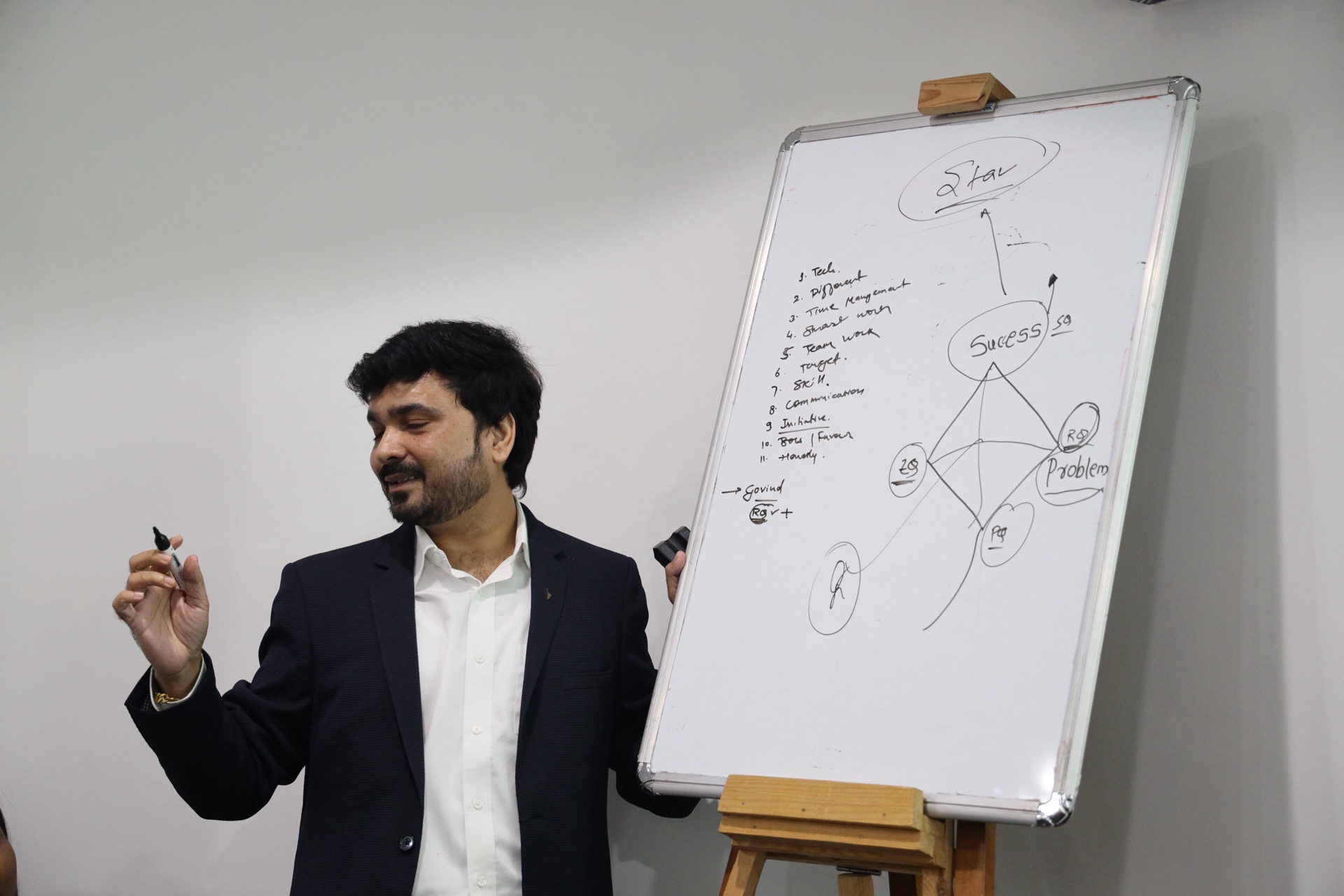
Meta-programs are the third tool on the RQ (Relationship Intelligence) side—the right edge—of The Winning Kite (KITE Leadership Framework). The first two RQ tools taught you to understand others and to listen actively. This one goes a layer deeper: not just what people say, but how their mind is wired to process it. On the kite, EQ (left) is mastering yourself, RQ (right) is mastering your relationships, PQ (bottom) is getting things done—and together they lift you to Success at the top. You rise on balance, not on any one strength alone. Read people well, and every other side of your kite gets easier.
What are meta-programs?
To build better workplace relationships, you have to understand how others think. The concept of meta-programs was first introduced by Richard Bandler and John Grinder, the co-founders of Neuro-Linguistic Programming (NLP). Here is the idea in plain language: your brain cannot process everything, so it constantly generalises, deletes and distorts incoming information. The rules it follows while doing that are your meta-programs. They shape what you notice, what you ignore, and how you decide.
I like to think of each person as having a unique communication key—like a mobile number. Dial it correctly and you connect instantly. Dial it wrong and the line simply won't ring, no matter how loud you shout. Below are five meta-programs I teach in the RQ tools of Stars at India Inc. Master these and you can adjust your own style to reach almost anyone.
1. Move Towards & Move Away
This is the pleasure–pain principle. Some people are motivated by moving towards pleasure and benefits; others by moving away from pain and loss.
Move Towards individuals focus on the upside—they get excited chasing rewards. Move Away individuals focus on what they could lose, and act to avoid it. The same message has to be framed two ways.
Take a sales pitch. For the Move Towards buyer, lead with the attractive discount, the limited-time price reduction, the bonus for early purchasers—everything they gain. For the Move Away buyer, a fear-of-missing-out (FOMO) angle works better: the offer closes soon, stock is limited, don't lose your chance. One person you pull with the prize; the other you nudge by protecting them from regret.
The point isn't manipulation—it's respect. You're handing each person the version of the truth their brain is built to hear.
2. Frame of Reference: Internal vs External
Where does a person look to decide whether they did well? People with an internal frame of reference rely on their own opinions and standards. People with an external frame rely on others' feedback, reviews and approval.
Consider Anita. She performs consistently well, yet she never feels satisfied until a colleague or manager praises her. That's an external frame of reference. To keep Anita motivated and reassured, give her regular feedback and appreciation—it reinforces her belief in her own ability.
Now take Raj. Raj is confident and trusts his own judgement to know he's doing a good job. He doesn't need external validation. With Raj, acknowledge his independence and self-assurance, still offer honest feedback when it's needed, and invite him to share his own view—because he values his perspective above the crowd's.
You'll see the same split even in something small, like convincing a friend to watch a movie. The external friend is swayed by ratings, reviews and awards. The internal friend is swayed by "this matches your taste; it's like that film you loved." Same movie, two different keys.
3. Sorting by Self & Sorting by Others
This meta-program is about focus: is a person more self-oriented or more others-oriented? Adapt your praise and your framing to match.
Imagine you lead a team and want to motivate two people. Ravi is more self-oriented; Priya is more focused on others. To lift Ravi, spotlight his contribution: "Ravi, your outstanding performance on the last project really helped us meet our deadline and exceed the client's expectations. Your hard work and dedication are truly commendable."
To lift Priya, spotlight the team: "Priya, your ability to collaborate and support your teammates has played a huge role in our success. Your team spirit makes our whole environment more productive and enjoyable." Praise Ravi for the team and Priya for herself and both fall flat. Match the sort, and both stand taller.
4. Matcher & Mis-matcher
Some people instinctively look for similarities and patterns—they are matchers. Others zero in on differences and discrepancies—they are mis-matchers. To reach a matcher, stress what's common and familiar. To reach a mis-matcher, stress what's new and different. In practice you'll see four flavours: matcher-similarities, matcher-differences, mis-matcher-similarities and mis-matcher-differences.
Say you're inviting two friends, Raj and Simran, to a party. For matcher-similarities Raj: "You know how much fun we had last time? This one's going to be just as amazing—same group, same great music." For matcher-differences Raj, tilt to the fresh angle: "This party will be even better than the last—there's a live band and a themed costume contest."
Simran leans mis-matcher. For mis-matcher-similarities: "This party will be different from the others, but you'll still enjoy it—it has some of the elements you loved before, like great food and dancing." For mis-matcher-differences: "This is a completely new experience—a unique venue, and games and activities we've never done before."
Once you can hear whether a person filters for sameness or difference, you stop accidentally arguing against their wiring—and start speaking with it.
5. Sensory style—and how much proof they need
People prefer different sensory channels. A visual colleague like Priya is convinced by slides, charts and graphs—use "imagine" and "picture this": "Priya, imagine the growth if we invest in this new marketing strategy—picture the rising sales and an expanding customer base." An auditory friend like Arjun responds to "listen" and "hear": "Arjun, listen to this podcast—you'll hear compelling reasons why it's time to change." A kinesthetic teammate like Ravi learns by doing: "Ravi, let me show you—once you get your hands on this software and feel how easy it is, you'll see why it's valuable."
There's a second dial too: how much evidence a person needs before they're convinced. Maya needs only a couple of strong data points—"we saw a 20% jump in productivity, and employee satisfaction is up." Rahul needs more—"our product cut production costs 30%; here are five case studies." Sunita is highly skeptical and wants everything—a comprehensive report with analysis, case studies, testimonials and expert opinion. Give a Maya a Sunita-sized report and you bore her; give a Sunita a Maya-sized pitch and you lose her.
How to spot a meta-program
You read meta-programs the way you read weather—by watching. Listen to the language people use, watch their behaviour, notice their preferences. Do they talk about what they want or what they fear? Do they quote reviews or their own gut? Do they say "same as before" or "totally different"? Those tells hand you the key. (Daniel Kahneman's work on how the mind takes mental shortcuts is a nice piece of supporting colour here—meta-programs are simply the individual shape of those shortcuts. The framework and the workplace application are my own.)
Putting meta-programs to work
Recognising and adapting to meta-programs pays off across the whole workplace:
| Situation | How meta-programs help |
|---|---|
| Team building | Let a Move Towards person lead the idea-generation; give risk assessment to a Move Away person. |
| Sales & negotiation | Sell benefits to Move Towards clients, safety to Move Away clients; match their sensory language. |
| Conflict resolution | Knowing each person's pattern lets you address their real concern and find middle ground. |
| Leadership | Use personal success to motivate internal/self people, group success for external/others people. |
| Recruitment | Hire candidates whose meta-programs fit the demands of the role. |
This is one of the tools I bring alive in my corporate training programs and deep-dive Signature Programs—because a team that can read each other's keys communicates faster, argues less and delivers more. It pairs naturally with the sibling RQ tools; if you haven't yet, anchor the whole picture with The Winning Kite.
The bottom line: people aren't difficult—they're just tuned to a different frequency. Meta-programs teach you to tune in. And every relationship you improve on the RQ side of your kite quietly makes you a stronger leader on every other side.
Bring These Ideas to Your Team
Avinash Chate turns the traits in Stars at India Inc. into live leadership & emotional-intelligence workshops. TEDx speaker · 11+ yrs training Army, BRO, RBI, BARC, JSW & 1000+ leaders.
✅ Thanks! Avinash team will reach out within 24 hours.'}).catch(function(e){f.outerHTML='Something went wrong. WhatsApp +91 8793630001
'});return false;">Select ServiceKeynote / Motivational SpeakingLeadership Development TrainingTeam Building WorkshopManager DevelopmentEmployee TrainingBook Avinash Now →Or WhatsApp directly: +91 87936 30001
Work with Avinash Chate
- Signature Corporate Training Programs →
- The Winning Kite (KITE Leadership Framework) →
- All Corporate Training Topics →
Avinash Chate TEDx Speaker · Founder, The Future Corporate · Author of Stars at India Inc. Avinash has trained the Indian Army, BRO, RBI, BARC, JSW Steel and 1000+ corporate leaders across India. His work focuses on leadership, emotional intelligence and behavioural training rooted in Indian values and modern business needs. |
Frequently Asked Questions
What are meta-programs?
Meta-programs are the mental filters that decide how a person deletes, distorts and generalises information—in short, how they think, get motivated and make decisions. First described in NLP by Richard Bandler and John Grinder, they explain why the same message lands very differently on two people. Reading someone's meta-program lets you dial their communication key correctly.
What is the difference between Move Towards and Move Away people?
Move Towards people are pulled by pleasure and benefits—show them the reward. Move Away people are pushed by avoiding pain or loss—address their concerns and use urgency (fear of missing out). Pitch the same offer as gain to one and as loss-avoidance to the other.
How do I motivate an Internal versus an External frame of reference person?
An External person, like Anita, needs praise, feedback and recognition to feel sure she did well. An Internal person, like Raj, trusts his own judgement and needs his independence acknowledged, not constant validation. Feed each the kind of proof they actually run on.
Where do meta-programs sit in the Winning Kite framework?
Meta-programs are the third tool on the RQ (Relationship Intelligence)—the right side—of the Winning Kite. RQ is how you understand and adapt to others; combined with EQ and PQ it lifts you towards Success at the top of the kite.
Related Articles by Avinash Chate
- Rahul – The Storm That Spread
- MS Dhoni & Chennai Super Kings: The Art of Developing Others
- Inside Hitachi Employee Training: What World-Class Corporate Culture Looks Like
Avinash Chate services
Corporate Trainer in Chennai · Top Corporate Trainers in India · Leadership Trainer in Chennai · Top Leadership Trainers in India · Team Building Trainer in Chennai · Top Team Building Trainers in India · Motivational Speaker in Chennai · Top Motivational Speakers in India · All service locations
← Back to all articles · Book Avinash Chate
By Avinash Chate — Maharashtra’s #1 Corporate Trainer & Motivational Speaker. .