Emotional Intelligence Training for a Sales Team in Pune: Muller-BBM
On 21 November 2026 I ran a day of emotional intelligence training for the Muller-BBM sales and marketing team in Pirangut, Pune. What we worked on, and what a sales team can take from it.
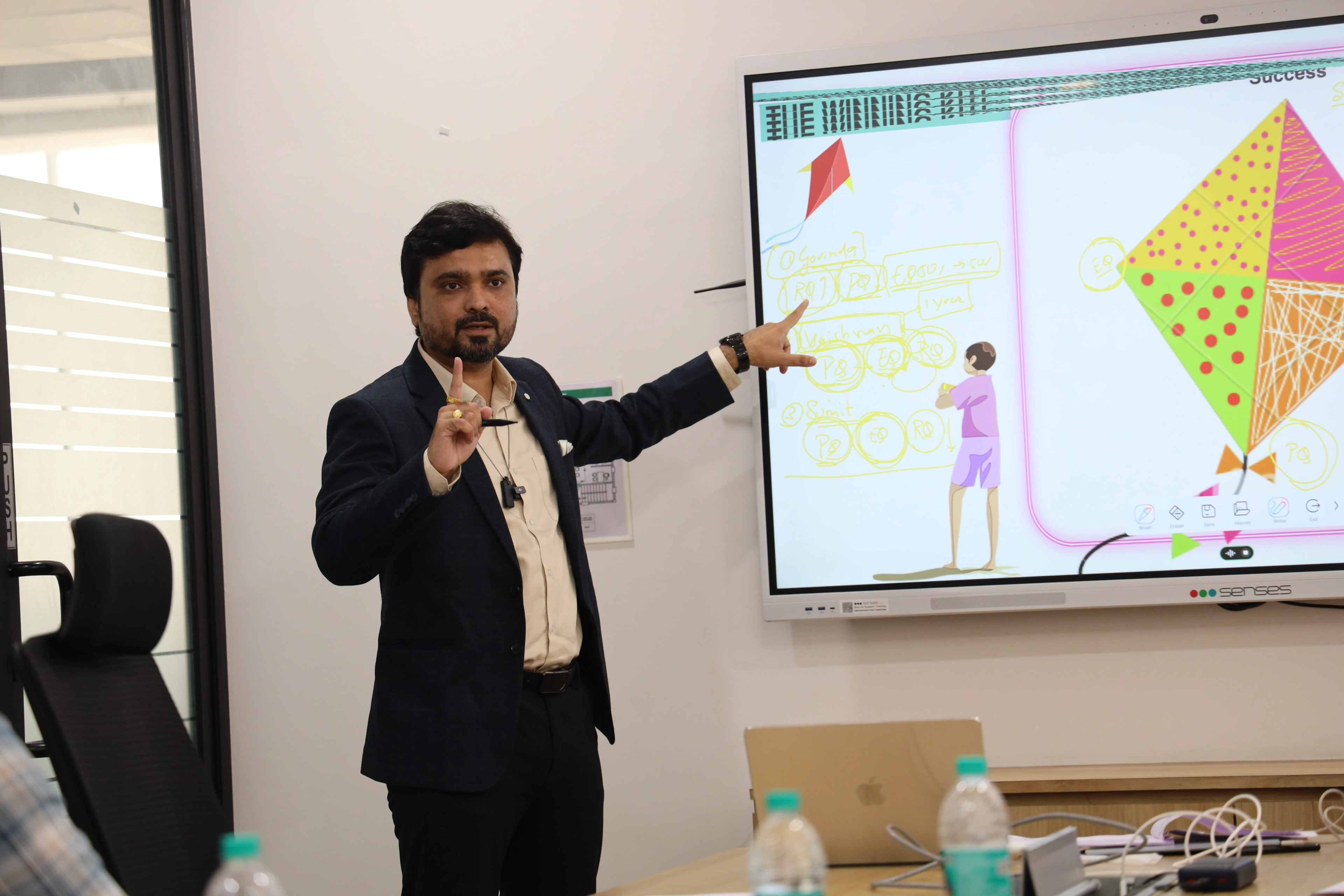
On Saturday, 21 November 2026, I ran a full day of emotional intelligence training for the sales and marketing team of Muller-BBM Acoustic Technology at their plant in Pirangut, Pune. It was Day 1 of a three-day programme we call Winning the Account. Seven people from the team were in the room, with sales and marketing experience ranging from three years to more than twenty. This post covers what we worked on, the exercises we used and what a sales team can take from it.
Why a sales team asked for emotional intelligence training
Muller-BBM works in industrial acoustics: silencers, enclosures, air intake systems and acoustic testing. The people who sell these products sit across from engineers, purchase teams and project heads. One wrong reaction in a tough meeting can cost an account that took a year to build.
Sachin, who has been with the company since 2005 and now leads marketing and business development, told the room why he had pushed for this programme. He wanted the team to learn to think differently from the competition, not to sit through one more routine training. That set the tone for the day.
I opened with a line I believe after many years of training: people are hired for IQ, but fired for EQ. Your knowledge gets you the job. How you handle yourself decides whether you are promoted or let go.
The Winning Kite: EQ, RQ and PQ for a sales career
The whole programme runs on my model, the Winning Kite. A career flies like a kite. Success sits at the top, and three sides hold it up:
- EQ, managing yourself. This was Day 1.
- RQ, working with people: customers, partners, difficult conversations and negotiation. This is Day 2.
- PQ, getting it done: systems, competitor analysis and AI agents for marketing. This is Day 3.
If one side is weak, the kite does not fly high or straight. We went through three people I have met in my work. One was brilliant with people but poor at follow-through, and his growth stopped at one level. One became a head of department on her results, then kept fighting with everyone, and the company had made a manager who turned out to be a damager. The third was the best technical person in his company but spoke to nobody, so his kite never left the ground. Each participant then scored his own kite, side by side, as strictly as he could.
The tower activity: watching emotions while you work
Three teams built a tower each. One team's tower stood straight without help.
The tower was only half the exercise. The other half was what each person felt while building: when the plan changed, when someone did not listen, when the tower leaned. This is how emotional awareness starts. You cannot control a feeling you have not noticed.
Triggers in sales and the meaning we give them
A trigger is a person, an event or a situation that pulls a strong reaction out of you. In sales they come every day: a customer who goes silent, a project put on hold, a colleague who blames you in a review. Your EQ does not decide whether triggers come. It decides how you respond.
When a trigger hits, the emotional mind tries to grab the steering wheel from the rational mind. Mike Tyson biting an ear and Zinedine Zidane's head butt in a World Cup final are what an emotional hijack looks like. I asked the team to let the emotional mind sit beside them, but to keep the steering in their own hands.
Most reactions start with the meaning we give to a situation. Two people get the same extra work. Mr B decides it is a plot against him and goes on leave. Mr A decides it is a sign of trust and becomes the star of the team. The meaning shapes the emotion, the emotion shapes the belief, the belief shapes the action, and the action gives the result.
Then the team shared real triggers from their own work, and these were the most useful minutes of the morning:
- A customer delays his reply, the project goes on hold and the salesperson gets blamed. One participant used to react sharply. Now he asks for extra time in the plan up front and keeps the customer informed.
- Another remembered giving a discount at a previous company to keep a customer, and losing the customer anyway because of a delivery delay. For that customer, time mattered more than price.
- A third used to say yes quickly to technical questions about a new product. Now he checks with his senior first and then answers.
- Many problems at work turn into a search for who is wrong. I asked them to move the question to what is wrong. That is usually where the real problem shows up.
I have written more on the first step in emotional awareness and on the next one in self-control under pressure.
A five-step way to solve any sales problem
Before lunch each person wrote his sales goal and then every problem standing between him and that goal. One participant listed eighteen. I shared the five steps I use with every team: goal, problems, diagnosis, design, action. A doctor first asks what is wrong and runs tests, and only then writes the prescription. A sales team should do the same, every quarter.
After lunch we sorted each problem two ways. Is it internal or external? External means nobody in the company controls it, like a war or the gold price. Is it technical or behavioural? Technical means we do not have the skill. Behavioural means we know what to do but do not own it. Almost every internal problem on their lists came out as a behaviour problem. In most companies I work with, more than nine out of ten problems are people problems. The good news is that these qualities can be learned.
Accurate self-assessment and blind spots
EQ has 25 qualities: 12 personal ones that make a good employee and 13 social ones that make a leader. None of them is inborn, and all of them can be developed, as long as a person stays coachable. The one who says "I know it all" does not grow.
Accurate self-assessment means giving yourself the right marks, not more and not less. Like a car, all of us have blind spots: things other people can see in us that we cannot.
I also told the story of Hanuman at the seashore. He had the strength to cross the sea and sat quiet, sure that he could not, until Jambavan reminded him who he was. A blind spot can be a strength you have not seen in yourself, and it often takes a well-wisher to point it out.
We then worked on the four drawers in which we file feedback:
- Compliment: good, it can stay.
- Criticism: bad, it has to change.
- Advice: good, but can be better, usually from someone senior.
- Suggestion: can come from anyone, even someone junior.
Most of us open only the first two. The feedback that makes you uncomfortable is often the one you need most. There is more on this in my post on accurate self-assessment and in feedback people act on.
We closed this part with a blind spot activity in pairs. Each person saw how a colleague reads him next to how he reads himself, and the gaps gave them something to talk about.
Initiative, trust and following the rules
In the last part of the day each person took a strict self-test on proactivity. Proactive people plan their day, warn a colleague before a mistake happens and stop problems early. I told them about a moment from the 1996 World Cup that I use to explain initiative.
We closed on two qualities that people often mix up. Trustworthiness is keeping your word. Conscientiousness is following the rule even when breaking it would suit you. It is stopping at a red signal when nobody is watching, and not offering two hundred rupees to get away when you are caught. Integrity is never fifty-fifty. A short guided reflection ended the day.
What comes next for the Muller-BBM team
Day 2 on 9 December covers relationships with customers and partners, difficult conversations and negotiation. On Day 3, on 12 December, we will look at competition and systems, and build dashboards and AI agents for marketing on the team's own data. Until then, each person keeps a daily self-awareness tracker in his workbook.
I am grateful to Sachin, to the HR team who arranged the day and to every participant for their honesty.
Want a day like this for your sales team?
I run emotional intelligence and sales training for teams in Pune and across India, in English, Hindi and Marathi. Call me on 87936 30001 or write to me here. You can also read about my corporate training work in Pune and see all my signature programmes.
Questions people ask
What is emotional intelligence training for a sales team?
It helps salespeople notice their own triggers, control their reactions with customers, read feedback well and take initiative. At Muller-BBM we did it through the Winning Kite, real sales situations from the team, a tower activity and a blind spot exercise in pairs.
How long is the programme?
Winning the Account runs over three days: EQ on Day 1, relationships and negotiation on Day 2, and systems and AI for marketing on Day 3. Each day stands on its own and has its own workbook.
Can the training be held at our plant or office in Pune?
Yes. The Muller-BBM session was held at their plant in Pirangut. All that is needed is a room with a screen and space for the activities.
Which languages is the training in?
English, Hindi or Marathi, or a mix, depending on the team. The Muller-BBM day was in a mix of Hindi and English.
Who is Avinash Chate?
I am a corporate trainer and the founder of The Future Corporate. I have been training working professionals since 2014. The Winning Kite comes from my book, Stars at India Inc.
The Winning Kite © Avinash Chate, Stars at India Inc.
Related Articles by Avinash Chate
- Sanjay Manjrekar Losing the Will to Practice
- AI Training for Sales Teams in Delhi NCR: Replies in an Hour
- Why Emotional Intelligence Is the Most Important Skill for Indian Managers in Mumbai
Work with Avinash Chate
- Motivational Speaking for Corporate Events →
- Best Motivational Speaker in Maharashtra →
- Team Building Trainer in Pune →
| AC | Avinash ChateIndia's Leading Corporate Trainer | TEDx Speaker | Author With 1000+ organizations trained including RBI, JSW Steels, and Ferrero, Avinash Chate delivers high-impact corporate training across India. Creator of the KITE Leadership Framework and bestselling author of "The Winning Edge." Website YouTube |
Avinash Chate services
Corporate Trainer in Pune · Top Corporate Trainers in Pune · Leadership Trainer in Pune · Top Leadership Trainers in Pune · Team Building Trainer in Pune · Top Team Building Trainers in Pune · Motivational Speaker in Pune · Top Motivational Speakers in Maharashtra · All service locations
← Back to all articles · Book Avinash Chate
By Avinash Chate — Maharashtra’s #1 Corporate Trainer & Motivational Speaker. .