The Lean Startup Book Review: 5 Lessons Indian Students Took Away at HNIMR
Team Lean Innovators reviewed The Lean Startup at HNIMR Pune. A tiffin MVP, a real pivot and Toyota's andon cord: five lessons for young founders.
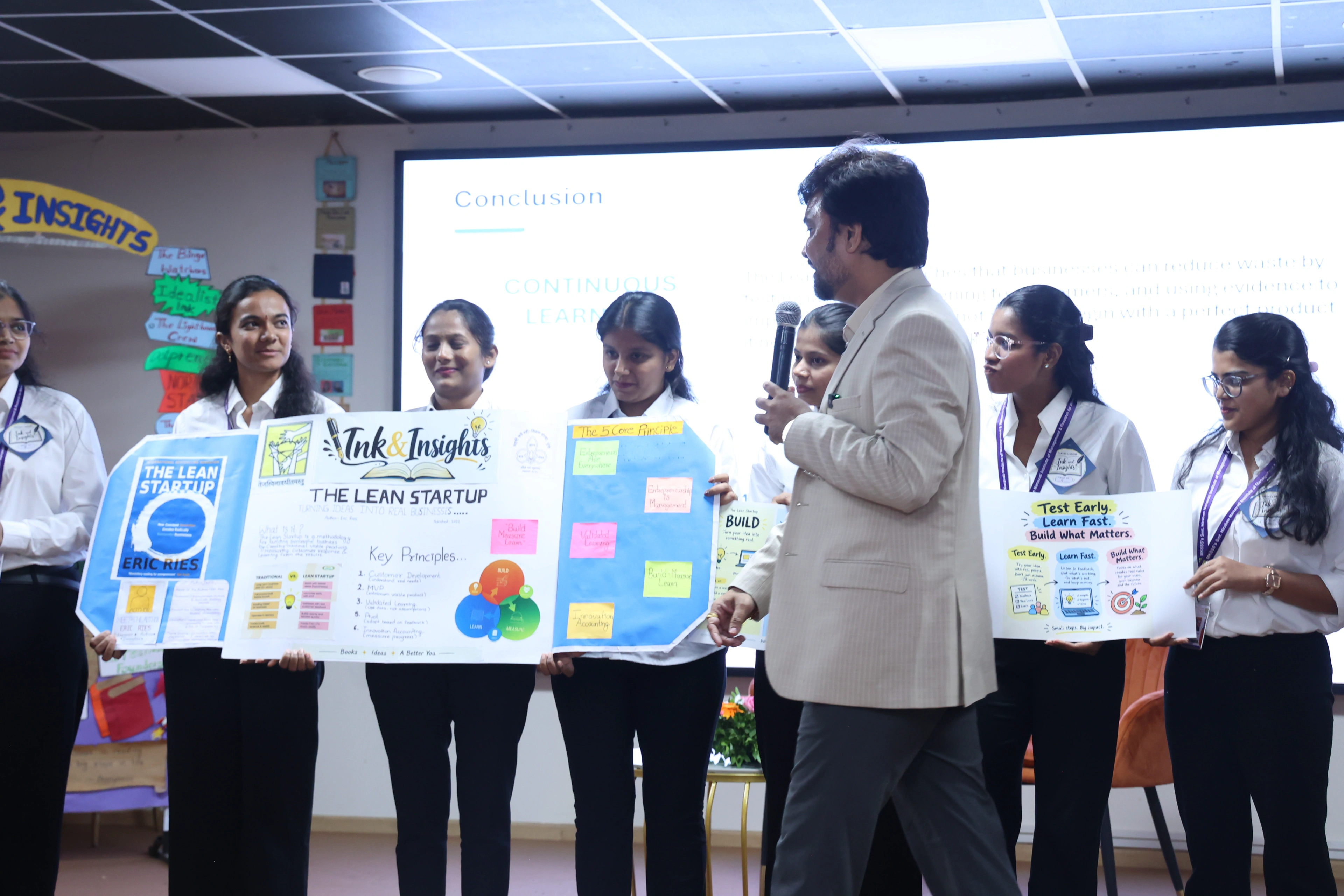
On 29 October 2026 I spent a full day at MKSSS's Smt. Hiraben Nanavati Institute of Management and Research for Women (HNIMR) in Karvenagar, Pune, as chief guest and judge of "Ink & Insights", a book review competition on the theme "Entrepreneurship: From Vision to Venture". Twenty-one MBA teams, twenty-one business books. The sixth team of the morning, Team Lean Innovators, picked a book I recommend to almost every first-time founder: The Lean Startup by Eric Ries, published in 2011.
What I liked is that this team did not stop at the theory. When I pushed them for real examples, they gave me real ones, including one from a student's own small business. That is exactly what this book is about.
How Team Lean Innovators presented the book
The team explained the heart of the book clearly. A business should not start with a perfect product. It should start small, with a simple version, and go round the build, measure, learn loop again and again. Identify the customer's problem, build a minimum viable product (MVP) with only the essential features, collect feedback, improve, and if the idea is not working, change direction. That change is called a pivot.
They also listed the real challenges a startup faces: limited time and cash, uncertainty about whether customers will like the product, numbers that look good but do not show real success, and the fear of changing your idea. Their six lessons were simple and useful:
- Test your assumptions before making any big investment.
- Start with an MVP instead of waiting for a perfect product.
- Listen carefully to customer feedback.
- Measure the results that actually matter.
- Be ready to pivot when your idea is not working.
- Learn from mistakes instead of repeating them.
Their closing line stayed with me: follow evidence, not assumptions.
My first question: where does the word "lean" come from?
I asked the team which company inspired the word "lean". They knew it was a Japanese idea but could not name the company. The answer is Toyota.
So I told them about the andon cord. You know the chain in an Indian train that you pull to stop it? Toyota's assembly line has something similar. A car moves down the line, one person fits the tyres, another fits the door, another the headlights. If even a fresher on that line feels something is wrong, he has the liberty to pull the andon cord and stop the line. Nobody shouts at him for it. The car goes back and the defect is fixed.
That is the spirit of lean. Keep improving small things, all the time, and give everyone the right to raise a problem. In my own company we run a "star felicitation" programme for exactly this reason, to celebrate small innovations that help the business.
The tiffin service test
Then I gave them a situation. Suppose you run a tiffin service for girls in a college hostel. How would you use an MVP?
The first answer was about the tiffin boxes, start with simple steel ones and upgrade to hot and cold boxes later. That is fine, but I wanted more. Another member gave the answer I was hoping for. Do not start with big plans and big customers. Try it with five or ten people first. See whether it works, improve it immediately where it does not, and only when the customer is happy and you are making money, move ahead.
I shared a story from my own office. A girl on my team once offered to organise a trip for a group of people. She did the bookings, handled everything, and slowly started enjoying it. Today she does not do a job. She runs a travel agency. Many of us have also seen a teacher who started tuition at home and grew it into a big coaching class. A startup does not mean renting a big office and hiring people on day one. Lean startup means try something small first, experiment, take feedback, and let it grow.
A real pivot from the room
When I asked for a pivot example, I said clearly that I did not want theory. One student said a restaurant whose cold coffee and some dishes are not selling should quickly update the menu instead of carrying on. Good, practical answer.
Then another student told us her own story. She was taking orders for blouse designs. But most of the enquiries she received were about classes, people wanted to learn blouse design from her. So she started teaching. Since then her classes have done far better than the orders ever did. That is a textbook pivot, and she did it before she had even read the textbook.
Measure progress, do not guess it
My last question was about what the book calls innovation accounting, measuring progress. There is a saying: what cannot be measured cannot be grown. When I coach business owners and ask them for their sales funnel, many cannot tell me.
In 2011 the book told founders to measure. Today we have far better tools. Every business needs a proper ERP, a proper CRM, proper software where all the data comes in, good reports from that data, and decisions from those reports. Not intuition. Not emotion. Data.
The example I gave was McDonald's in India. In the beginning the response was low, so they studied what Indians like. We love vada pav and aloo tikki. So came the McAloo Tikki burger. Honestly, it is not their original idea, they picked it up from our own streets and served it back to us. But it is a great example of learning from customers and changing the product.
5 lessons for an Indian student or young founder
1. Start with five customers, not five lakh rupees
Before you spend on a kitchen, a shop or an app, serve a handful of real customers. Their behaviour will teach you more than any business plan.
2. Your MVP is a learning tool, not a cheap product
The point of the minimum viable product is to learn something real. Ask yourself, what is the one thing I need to find out, and what is the smallest thing I can build to find it out?
3. Listen to where the enquiries come from
The blouse design story shows it. Customers often tell you what business you should be in. Write down every enquiry and look for the pattern.
4. Give everyone the andon cord
Even in a team of three, make it safe for anyone to say "this is not working". Small problems caught early are cheap. Big problems caught late can close a business.
5. Put numbers on your progress
Track a few numbers every week, such as customers who came back, orders and enquiries. A simple sheet is enough to begin. Decide with data, not with feelings.
Team Lean Innovators showed that this book is not about Silicon Valley. It is about a tiffin service, a blouse class and a menu card in Pune. Start small, test, listen, measure, and grow.
If you run a college or company
I run book review sessions, entrepreneurship workshops and practical business learning programmes for colleges and companies, where students and teams learn ideas like these by doing, not just by listening. If you would like one for your campus or team, get in touch with me here.
With thanks to HNIMR
My thanks to Dr. Priyanka Singh, Director of HNIMR; Mrs. Manjushree K. Nawale, Librarian, and her library team, who organised Ink & Insights 2026; Mr. Vishwajeet Deshmukh, Placement Officer; Mr. Devadatta Sant; and Ms. Minal Kotwal, for hosting me so warmly and making the day run so smoothly. And to every student who stood on that stage with a book in hand: thank you for the courage and the creativity.
Related Articles by Avinash Chate
- How Joe Girard Sold 13,001 Cars: The 'I Like You' Sales Secret India
- Why Ford Failed in India: The Entry-to-Exit Business Case Study Every Leader Must Know
- Sugarcane Worker कुटुंबातील मुलं School का सोडतात?
Work with Avinash Chate
- Best Motivational Speaker in Pune →
- Signature Corporate Training Programs →
- Best Motivational Speaker in Maharashtra →
| AC | Avinash ChateIndia's Leading Corporate Trainer | TEDx Speaker | Author With 1000+ organizations trained including RBI, JSW Steels, and Ferrero, Avinash Chate delivers high-impact corporate training across India. Creator of the KITE Leadership Framework and bestselling author of "The Winning Edge." Website YouTube |
Avinash Chate services
Corporate Trainer in Pune · Top Corporate Trainers in Pune · Leadership Trainer in Pune · Top Leadership Trainers in Pune · Motivational Speaker in Pune · Top Motivational Speakers in Maharashtra · All service locations
← Back to all articles · Book Avinash Chate
By Avinash Chate — Maharashtra’s #1 Corporate Trainer & Motivational Speaker. .