Soft Skills Training in Singapore
Your regional head asks the room whether anyone has concerns. Nobody does. Six weeks later the plan has failed for a reason two people in that room could have named on the day — and neither of them was going to say it in front of him. Avinash Chate runs soft skills training in Singapore for teams where that pattern is costing real money.
Singapore · Regional-HQ and multinational teams · India-based, travels for engagements
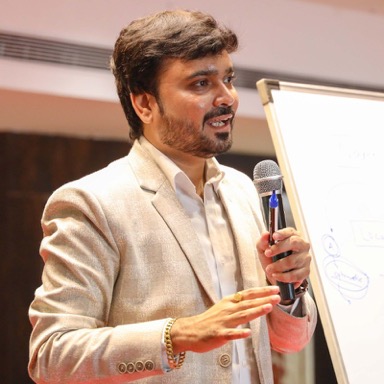
Everyone in the Room Already Knows the Theory
The usual explanation for a soft skills programme not landing is that the group was resistant. In Singapore that explanation is almost always wrong, and getting it wrong is what wastes the budget.
This is not a risk-averse room. An unfamiliar method or an uncomfortable exercise gets taken on without complaint, and without having to be sold in first. Facilitators who arrive braced for scepticism are braced for the wrong thing, and they spend the first hour warming up a room that was already warm.
And it is not an uninformed one. Almost everybody in a regional-headquarters cohort has sat through communication training before. They can define active listening, they know feedback is supposed to be specific and timely, and they will hand the theory back to you accurately if you ask for it. The knowledge is not what is missing.
What is missing is the sentence, at the second it is needed. A manager declining a request from someone two levels above him, holding a deadline against a market head, or telling a peer that the handover was late again, is not searching for a model. He is searching for the first eight words. If those are not available in the two seconds he has, he says nothing and composes the perfect version in the lift afterwards. Candour in these teams travels downward without friction and upward almost not at all — the country scores behind that are on the leadership training page — but the practical failure is smaller and more fixable than the culture argument makes it sound.
So the work is rehearsal rather than exposition. Participants say the actual words, badly, in front of people whose opinion they care about, until the words are available under pressure instead of afterwards. A session that only describes the skill leaves the room where it found it, which is why a group that enjoyed the training reports nothing different a month later.
What the Programme Covers
Every programme is scoped to the behaviour you need changed. These are the modules Singapore-based teams ask for most, and each one links through to the full topic page.
Communication Across Differing Norms
Mixed teams rarely break down over vocabulary. They break down over how direct a person is expected to be with a senior, and over whether silence in a meeting reads as agreement or as an objection nobody wanted to voice. The session gets those expectations stated out loud so the team can settle on one working rule instead of each member guessing from their own. See cross-cultural communication.
Difficult Conversations Up a Hierarchy
Telling a senior the plan will not work is a different act from telling a peer. In a high power distance, low individualism setting it also carries a cost to the group, not only to the speaker. The module treats that as the real constraint rather than lecturing about the value of candour, and works on getting the objection into the room without anyone having to visibly contradict a senior. See difficult conversations.
Assertiveness Without Confrontation
Most people are not choosing between assertive and aggressive. They are choosing between saying nothing now and saying it badly a month later. Participants practise the actual sentences — declining a request, holding a deadline, flagging a risk, correcting an assumption — until the words are available under pressure rather than composed afterwards in the lift. See assertiveness training.
Presentation Skills and Executive Presence
A regional role means presenting to people who did not grow up reading your signals, often over a video link, often after two other presenters. The work is on structure, on the first ninety seconds, and on holding a room that is not obliged to be interested. See presentation and public speaking and executive presence.
Service Recovery Under Pressure
Front-of-house and client-facing teams meet people at the worst minute of their day, and a scripted courtesy makes that minute worse. The module is about recovery — reading what has actually gone wrong, saying so, and closing it — rather than about politeness drills. See customer service excellence.
Handling Difficult People and Pressure
Most teams carry a stakeholder who blocks work without saying why, a counterpart in another market who agrees in the meeting and does nothing after it, and a manager who raises the volume instead of the point. Participants practise reading what is driving the behaviour and answering it without escalating, using the emotional-intelligence tools in the KITE Leadership Framework. See handling difficult people.
Formats
A one-day workshop on a single behaviour, which is the format most Singapore schedules can absorb without disrupting a quarter. A two-day programme when the objective is a set of behaviours rather than one. A staged programme run across two visits with a virtual module in between, so the practice has somewhere to land and the second visit starts from evidence rather than from recap. A batch series when the population is large and you want groups small enough that everybody role-plays. And a shorter keynote-style session for a town hall, an annual day or a regional kickoff — scoped honestly as awareness rather than sold as a workshop. The behavioural skills and workplace etiquette modules slot into any of these.
In Practice
Scoping starts with the audience split, not with the topic. A regional leadership cohort, a first-line supervisor group and a client-facing service team have three different versions of the same problem, and running them as one batch produces a session that is slightly wrong for everybody. The split is agreed on the first call and the outline follows from it.
The design question that matters most is how dissent gets into the room. That is a facilitation decision rather than a content one, it is agreed with you during scoping, and it decides whether the group practises or only watches a practice being described by someone else. What it is not is a demand that anyone contradict their boss in public — that request fails in this room, and asking for it is how a facilitator loses the group in the first hour.
The funding question, answered before you have to ask it. Every competing page in this market leads with a SkillsFuture or WSQ badge, so silence on it reads as evasion. These programmes are not SSG-funded and cannot be. Course fee grants flow to Citizens and Permanent Residents only, an Registered Training Provider needs a Singapore UEN, and since 1 April 2026 the trainer assigned to a funded certifiable course must hold WSQ ACTA or ACLP and sit on the National Adult Educator Registry. That narrows the subcontracting route for those courses too, because the funding claim would fail on the trainer rather than on the entity. For a regional-HQ cohort it changes little: with roughly forty per cent of the labour force on work passes, a large part of that room was never subsidy-eligible in the first place, and the budget it is bought from is your own.
Where an accredited local provider is the better answer. If the cohort is wholly Singaporean, the objective is a certifiable qualification and the funding is the reason the programme exists, an ATO is the right call and this is not a competitive pitch. The honest overlap is the unfunded half of the market — regional teams, mixed-passport rooms, offsites, keynotes and leadership cohorts where nobody in procurement ever asks about SkillsFuture.
And the honest boundary. Avinash Chate is based in Maharashtra, India, and travels for engagements. There is no Singapore office, no Singapore entity, no UEN and no local licence, and no past delivery in Singapore or Singaporean client list is being claimed. What is on offer is a named, verifiable individual rather than a course catalogue: 80-plus organisations and 25,541-plus professionals trained, 4.9 stars from 202 Google reviews, a TEDxBEC talk, two published books and the KITE Leadership Framework, with the working evidence in the training evidence register and its public source library.
From the room
Real sessions, photographed as they ran.
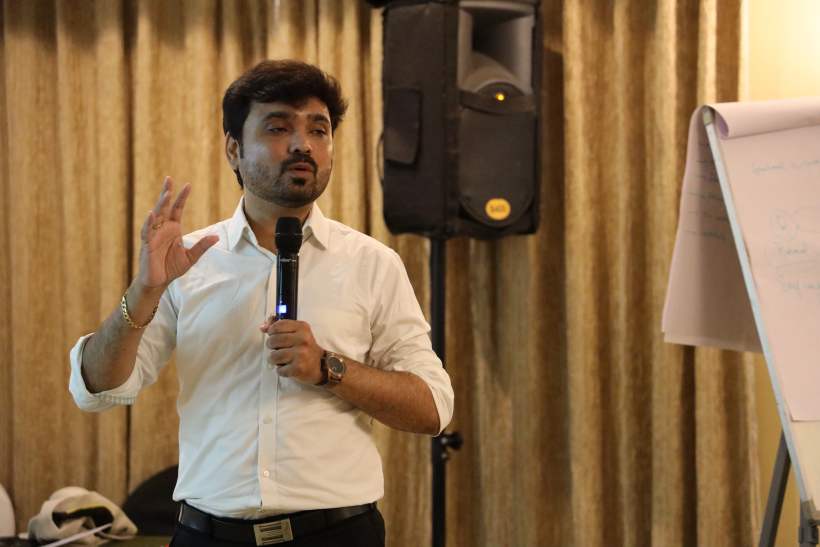

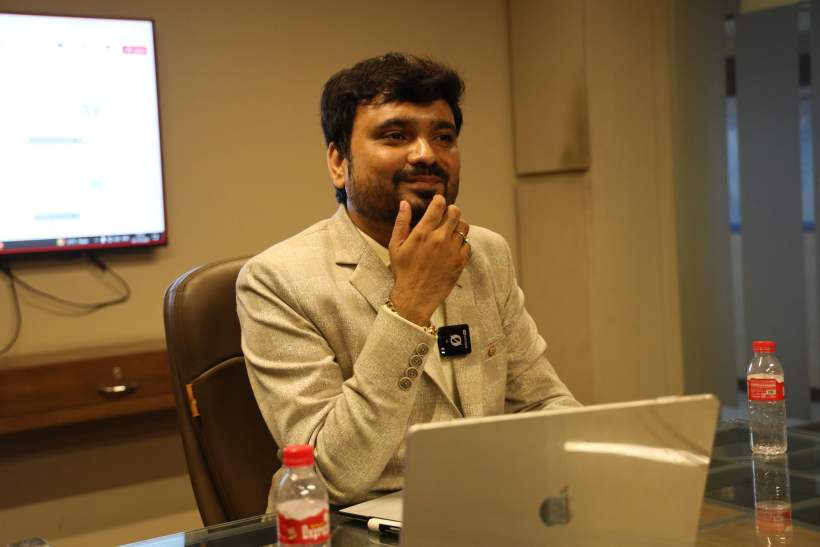
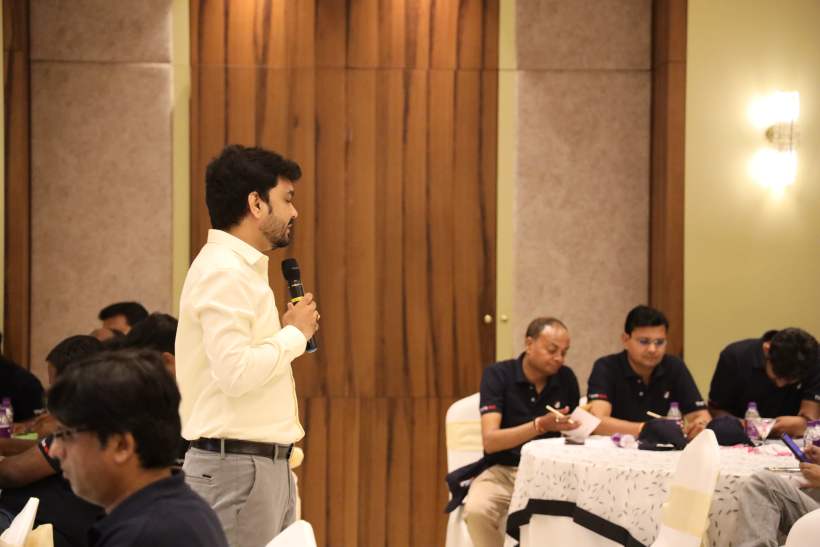
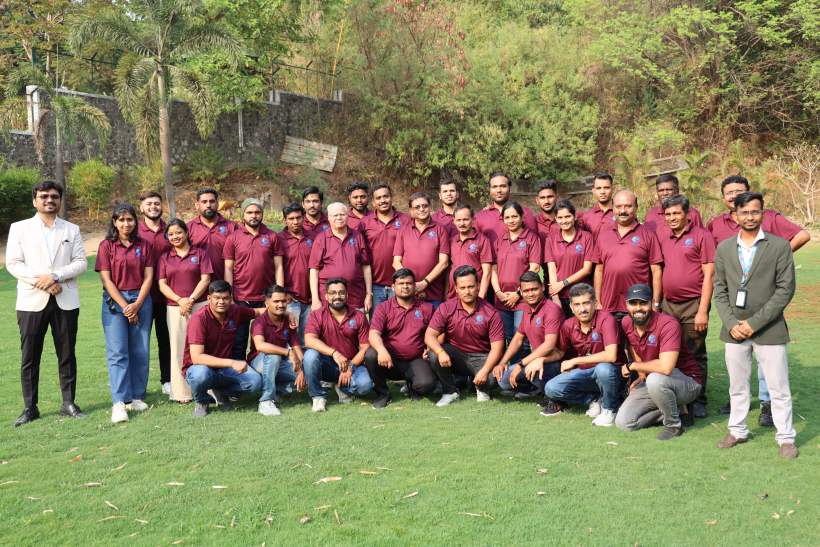
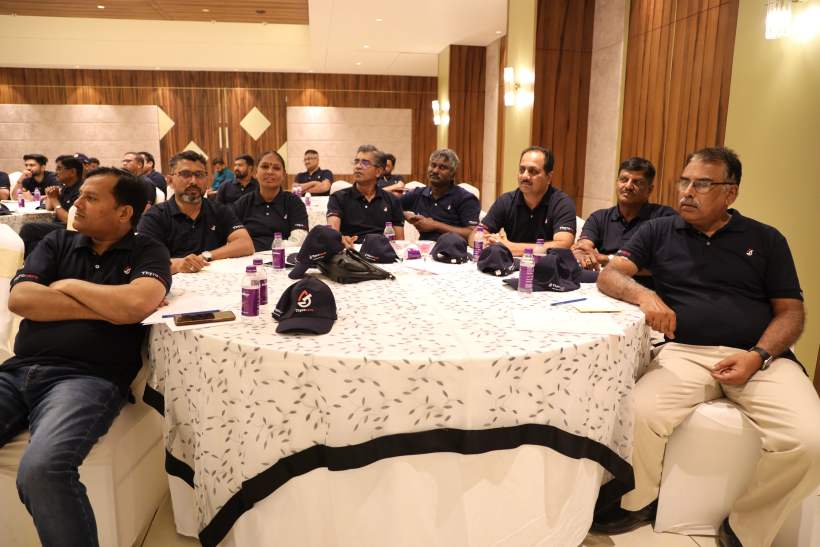
Photographs from Avinash Chate's own sessions in India. Sessions in this market are delivered by the same facilitator, in the same format.
Planning a soft skills programme in Singapore?
Share your name and WhatsApp number and you will get a reply within one business day — usually the same day. Tell us the audience groups and the behaviour you need changed, and the outline follows.
Prefer to talk now? ☎ +91 87936 30001 · WhatsApp · Email
Sectors Served
Regional headquarters first, because the fit is structural rather than incidental — the managers inside the regional-headquarters cluster run teams across India, South East Asia and Greater China, which is exactly the room described at the top of this page. Banking and financial services second: the Monetary Authority of Singapore puts the sector at more than 2,500 licensed financial institutions employing close to 200,000 people, and the desks that are not chasing IBF-accredited content are the ones this work suits. Shipping, maritime and logistics third, at roughly seven per cent of GDP and around 170,000 professionals, where the rooms are multinational, hierarchical and safety-critical, and the supervisor and difficult-conversation problems are the familiar ones.
Manufacturing on Jurong Island fourth, where more than 100 energy and chemicals companies employ around 27,000 people and the plant-culture problems map closely onto work already delivered for manufacturers in India. Professional services teams inside the headquarters cluster. And hospitality, where the tourism workforce grew from 69,000 to 75,000 between June 2023 and June 2025, though that sector leans heavily on subsidised training and is the weakest fit for an unfunded offer.
Frequently Asked Questions
How is an India-based trainer engaged for soft skills training in Singapore?
Directly, by your own learning and development team, to train your own employees, in your own offices or at a venue you book. You brief the outcome, you approve the written outline, and Avinash Chate flies in for the delivery dates. He is based in Maharashtra, India, and travels for engagements — there is no Singapore office, no Singapore entity, no UEN and no local licence, and none is being claimed. A direct in-house engagement is the arrangement most regional-HQ L&D teams already use for a visiting specialist, and it is the cleanest contracting route here.
Are these programmes SkillsFuture, SSG or WSQ funded?
No, and it is worth saying so plainly rather than leaving it to be discovered. SSG course fee grants flow to Singapore Citizens and Permanent Residents only. An Registered Training Provider must be a registered Singapore entity holding a valid UEN. And since 1 April 2026 an adult educator assigned to an SSG-funded certifiable non-WSQ course must hold WSQ ACTA or ACLP, or an SSG-deemed equivalent, and be listed on the National Adult Educator Registry. He meets none of those three tests, so the funded route is closed. These are commercially budgeted programmes, bought out of L&D or business-unit budget the way a regional cohort is normally bought anyway.
Does an unfunded programme actually make sense for a Singapore team?
For a regional-HQ room it usually does, because that room is largely un-subsidisable to begin with. Roughly forty per cent of Singapore's labour force holds a foreign work pass, and of the 55,500 jobs added across 2025, 43,900 went to non-residents. If half the people in your leadership cohort are Employment Pass holders, no provider — accredited or not — can get that half funded. Keynotes, kickoffs, dealer and partner meets and offsites are almost never routed through course-fee funding either. Where the cohort is wholly Singaporean and the objective is a certifiable course, an accredited local provider is the better answer, and that is a fair thing to say out loud.
Does he need an Employment Pass, and who handles the immigration side?
No Employment Pass. Under the Ministry of Manpower's Work Pass Exempt Activities, carrying out activities directly related to organising or conducting a seminar, conference, workshop, gathering or talk — as speaker, moderator, facilitator or trainer — is an exempt activity, subject to notifying MOM on arrival, before it begins, up to a cumulative ninety days in a calendar year. Where the exemption does not apply, the route is a Miscellaneous Work Pass. Your side files the notification with the event details, the dates and the venue, and it is worth confirming the current route with MOM at the time of booking. Note the exclusions: the exemption does not cover an event whose main purpose is selling or promoting goods or services, or one relating to religion, race or community, or a cause-related or politically directed event. A corporate soft skills workshop is none of those, but the scope is worth checking against the agenda before dates are held.
How much lead time does a Singapore programme need?
Four to six weeks is comfortable. Two weeks for the brief, the audience-group split and the written outline, and the rest for scheduling around your own operating calendar and for the MOM notification. Shorter turnarounds are possible for a single keynote or a half-day session where the outline is already agreed. The thing that genuinely eats lead time is not the paperwork — it is getting a regional cohort whose members sit in four countries into one room on one date.
What group size works for a soft skills workshop?
Twenty to thirty people is the range where every participant still gets to speak, practise and be corrected, which is the whole point of behavioural work. Up to about sixty is workable when the objective is awareness rather than skill drilling. Beyond that it becomes a keynote with activity in it — a legitimate format for a town hall or an annual day, and one that should be scoped as a keynote rather than sold as a workshop.
Which language is the programme delivered in?
English. A Singapore regional-HQ or professional-services room is an English room and is run as one, and the sessions, the materials and the practice all sit in English. Hindi and Marathi are additional delivery capabilities most facilitators on this circuit do not have, and they matter on multi-site programmes where the same content also has to land with an operations audience in India — the framework and the facilitator stay the same instead of being handed to a second, junior, language-matched trainer.
Can the programme run online instead of in person?
Yes, and for a cohort spread across Singapore, Kuala Lumpur, Jakarta, Mumbai and Shanghai it is often the sensible first module. Online carries frameworks, self-assessment and short practice in breakouts perfectly well. It carries badly the parts that need a room — reading the pause before someone disagrees, difficult-conversation role-plays, and the moment a group finally says the thing it has been circling for an hour. Most programmes settle into a virtual opener followed by in-person practice days.
What does the proposal contain?
The outcome you named, written back as a measurable objective. A session-by-session outline. The activities and role-plays with the behaviour each one targets. The audience-group split and the format that follows from it. Duration, group sizes and the number of batches. The travel and MOM notification requirements. And what happens after the session — the reinforcement material and the manager follow-through. You see the outline before anyone books a flight, not a course-catalogue page number.
What does soft skills training in Singapore cost?
There is no list price, because the variables genuinely move the number: the format, the number of days, how many batches have to be run to keep group sizes small enough for practice, whether the programme is one visit or staged across two, and international travel. A quote is built from those inputs and issued in writing. Share your dates, the audience groups and the behaviour you need changed, and you get it within one business day. The enquiry page is the fastest route.
Plan Your Singapore Programme
To scope it, share the audience groups and roughly how many people sit in each, whether the cohort is Singapore-only or regional, your date window, and the one behaviour the programme has to change. A call follows within one business day, and you get a written outline before anyone books a flight.
Soft skills training for your Singapore team?
Communication, difficult conversations, assertiveness and service — delivered in English, by one facilitator, scoped to the audience groups you brief.
Check Date Availability →