Corporate Training Companies in Dubai
Most corporate training companies in Dubai assign the facilitator after the contract is signed. You buy the institute and its accreditation, and you meet the person who will stand in front of your people afterwards. This is a buyer guide to that choice, written to include the briefs where the institute is the better buy. Avinash Chate is one name on the shortlist — India-based, flies in, delivers in English, Hindi and Marathi.
Dubai · Abu Dhabi · Sharjah · English, Hindi and Marathi

How Corporate Training Is Actually Sold in Dubai
The supply side in the Emirates is built out of licensed institutes rather than individual practitioners. That single fact shapes what you are sold, who turns up to deliver it, how the number on the quote is arrived at, and what your competitors are buying this year. All four are worth checking while the shortlist is still open.
The product is a catalogue. A provider publishes a list of programmes running one to five days, with public open-calendar dates, and most of them carry an external accreditation — ILM, City & Guilds, CIPS, PMI and similar. The same programmes are also offered as bespoke in-company delivery, customised to your industry, usually with a group discount from six or more delegates.
The trainer is anonymous until you sign. You are buying the institute's name, its accreditation and its bench. A facilitator is assigned from that bench, and which one you get depends on who is free that week. For a certification course that is entirely reasonable. For a behavioural programme, where the whole result rests on whether one person can hold a difficult room, it is the thing you have least visibility of.
Almost nobody publishes a price. Request a Quote is the norm, so a like-for-like comparison takes real effort. Note the unit as well as the number: institutes usually price per delegate against a published course, while an individual prices per session for the whole room. Those two shapes cross over quickly once a cohort is more than a handful of people.
Demand is not evenly spread. Two forces drive most of the briefs being written now. Emiratisation targets oblige private-sector firms above fifty employees to raise the share of UAE nationals in skilled roles every half-year, with a monthly penalty for each unfilled position, which puts a wave of new national hires into teams run by expatriate line managers. Separately, government and enterprise digital-transformation programmes have made AI upskilling a standing budget line. Both of those arrive as the same shopping list: coaching, feedback, first-time-manager capability and cross-cultural communication.
Training Company or Individual Practitioner
Six differences change the outcome. Some of them favour a provider and some favour an individual, so read the row that matches your brief.
Who Delivers on the Day
With a provider you contract the organisation and meet the facilitator later. With an individual you can watch the person speak, read what they have written and check their record before you commit — and the person you evaluated is the person in the room.
Accreditation or Framework
An institute sells an external certificate, which is exactly what you want when the participant needs a recognised qualification. A practitioner sells a body of work — in this case the KITE Leadership Framework and the books behind it. Decide which one your people will actually use afterwards.
How Language Is Solved
Several UAE institutes do offer Hindi and Urdu, and they solve it by assigning a second, language-matched trainer. Your leadership session and your frontline session are then delivered by two different people at two different levels of seniority. One facilitator who runs both is a different product.
Catalogue or Brief
A catalogue programme is proven, dated and easy to buy. A designed programme starts from the behaviour you need changed and is built backwards from it. If your problem is generic, the catalogue is faster and cheaper; if it is specific to your business, the catalogue will feel borrowed.
Scale and Bench Depth
This one goes to the provider without argument. Four hundred people across three sites in one week, a rolling induction calendar, a certification track with exams and invigilation — that is a company's job. One person cannot be in two rooms, and pretending otherwise wastes your time.
What Happens Afterwards
Ask who runs the reinforcement session two months later. With an individual it is the same person, holding the same references from the same room. With a larger provider it may be whoever is available, which is fine for content and weak for continuity.
When a Training Company Is the Better Choice
Do not shortlist an individual for work that is genuinely an institute's job. If your people need an externally recognised certificate, if you are running a technical or compliance curriculum, if you have three delegates rather than a cohort and want a published open-calendar date, or if you need several hundred people covered across sites inside one week, a licensed provider will serve you better and faster.
The same applies to anything requiring a standing local presence — a year-round academy, an induction calendar that runs every month, an onsite learning partner embedded in your HR team. A visiting specialist is the wrong shape for that, and any visiting specialist who tells you otherwise is selling.
An individual practitioner earns the slot on a narrower set of briefs. Two of them are a leadership cohort where the facilitator's judgement is the product, and a conference or annual meet where one session has to shift the mood of the room. The third is a behavioural programme for supervisors who will not open up in English. In all three the same person should design the work, deliver it and come back for the follow-through.
What to Ask Before You Sign
Ask every provider on your shortlist the same set of questions and the differences stop being about brochures. Most of these have a single-sentence answer, and a vendor who cannot give it has told you something useful.
How to Check a Trainer Is Real
A training record is easy to assert on a website and harder to check. These four checks separate a record from a claim, and you can run all four from your desk without asking the vendor for anything.
Find the primary source, not the claim. A TEDx talk should be findable on TED.com under the speaker's own name. A book should have an ISBN and a retail listing. Press coverage should open on the publication's own domain, not as a screenshot. On this site those are gathered in the citation register and the published training evidence page precisely so you can check them rather than take them on trust.
Read the reviews with names attached. Unattributed testimonials on a vendor's own page prove nothing. A Google Business profile with a rating, a review count and identifiable reviewers is a different order of evidence — this practice carries 4.9 stars from 202 reviews, and the reviews page collects them.
Treat a client list as an engagement record, not an endorsement. Avinash Chate has worked with 80-plus organisations and about 25,541 professionals, among them the Reserve Bank of India, JSW Steel, BARC, Ferrero, Mumbai Port Authority, the Indian Army and the Border Roads Organisation. A UAE buyer with a large Indian workforce should read a central bank, a steel major, an atomic research centre and the army as harder rooms than a Dubai SME, not softer ones. The full list is on the clients page.
Then check what the vendor does not claim. Avinash Chate is based in Maharashtra, India, and travels for engagements. There is no UAE office, no UAE entity, no UAE licence, no Emirati client list and no past delivery in the Emirates being claimed on this page. What is on offer is a trainer who flies in, and who will run the same programme in English, Hindi or Marathi for a workforce that is largely Indian and South Asian. The scope, travel and contracting side of that is set out on the international engagements page.
Formats
Four formats cover most UAE briefs. A ninety-minute keynote sits inside a leadership offsite or an annual meet. A full-day in-company workshop suits a cohort of fifteen to thirty. A two-day programme is the right size when the brief is behaviour change rather than exposure, which is where most leadership and first-time-manager work lands. A conference session scales to several hundred people. Add a reinforcement session six to eight weeks later, run by the same facilitator, so the room has to account for what changed. Travel is planned around the Monday to Thursday block, and around the Ramadan and summer calendar.
From the room
Real sessions, photographed as they ran.
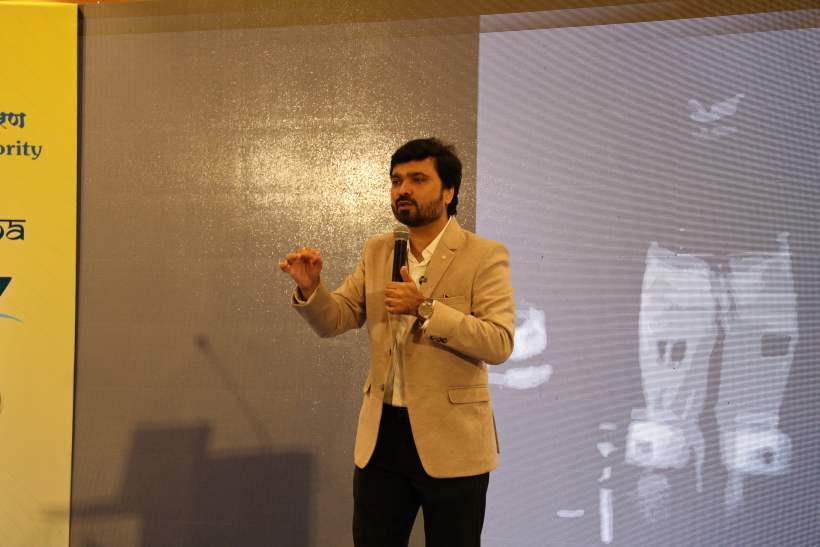
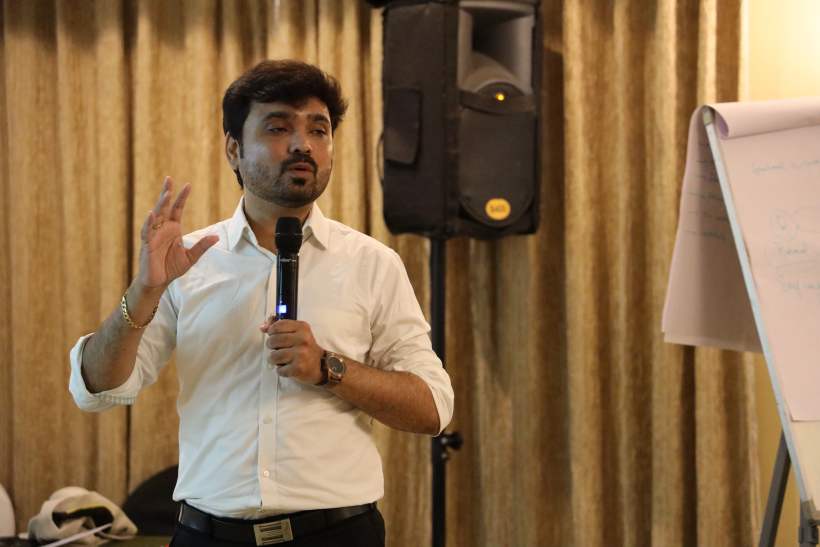

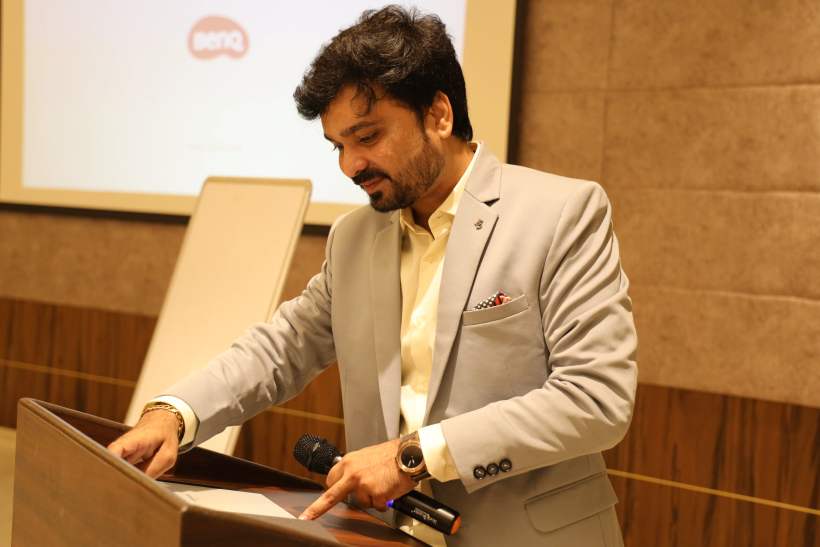

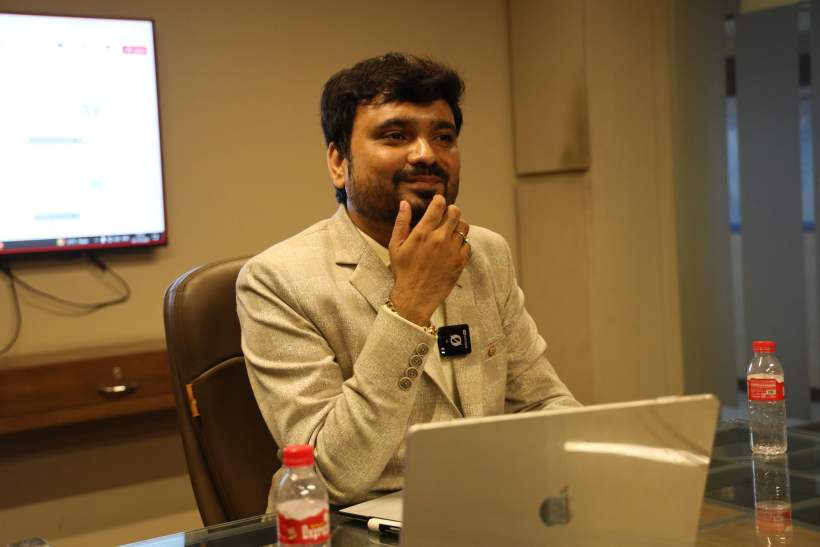
Photographs from Avinash Chate's own sessions in India. Sessions in this market are delivered by the same facilitator, in the same format.
Comparing training providers for a Dubai brief?
Share your name and WhatsApp number and you will get a reply within one business day — usually the same day. Or call directly, most dates are scoped on a phone call.
Prefer to talk now? ☎ +91 87936 30001 · WhatsApp · Email
Sectors Served
The right format changes with the audience, and in the Emirates the audience changes by district. Financial and professional services in DIFC and technology firms in Dubai Internet City mostly work in English, and they promote people into management faster than they train them for it. Commodities, energy and technology companies in DMCC include a large share of founder-led firms at the point where the owner has to start managing rather than doing.
Logistics, freight and terminal operations in JAFZA and around Jebel Ali are the other end of the same market: supervisors promoted off the floor, running crews that do not work in English. Hospitality and tourism, retail, healthcare groups, contracting and facilities management sit in between, with shift-working multilingual frontline teams and an English-speaking management layer above them. Abu Dhabi's energy sector buys through formal vendor registration and a longer procurement cycle, which is worth starting early rather than late.
Programmes That Fit These Briefs
The two briefs a UAE buyer raises most often are a leadership layer that grew faster than its training, and a supervisor layer that was promoted for technical skill. The Leadership Development Program and Becoming a Star at the Workplace are the flagship answers to those, and the frameworks behind them are set out in The Winning Edge.
Frequently Asked Questions
How does a UAE company engage an India-based corporate trainer?
The clean route is the one most L&D teams already use for a specialist: your organisation engages the facilitator directly to train your own employees, in-house, under your own contract. The commercial side is simpler than most buyers expect — as things stand the UAE applies no withholding tax to service fees paid to a non-resident where the income is not attributable to a permanent establishment here, and under the VAT reverse charge a VAT-registered UAE client accounts for the tax itself, so there is no UAE VAT registration at the supplier's end. Your finance team should confirm both against your own position, but it means the invoice is usually settled in full with no deduction at source.
Does the trainer need a visa or a work permit to deliver in the UAE?
Yes, and it is a routine piece of paperwork rather than an obstacle. MOHRE's mission work permit exists for exactly this — short assignments by a specialist brought in from outside the country, sponsored by the UAE host entity, valid for ninety days and extendable by ninety more. Approval runs through MOHRE and then GDRFA, or through the free zone's own immigration portal if you sit inside one. Processing is typically a handful of working days. Your PRO handles it; a visit visa is not the compliant route for paid delivery, so plan for the permit rather than around it.
How much lead time does a session in Dubai need?
Four to six weeks is comfortable and three is usually workable. That window covers the diagnostic call, the written outline, your sign-off on the content, and the permit paperwork on your side. Travel is rarely the constraint: Mumbai and Pune to Dubai is about a three-hour flight with several services a day. The approval chain inside your own organisation usually takes longer than the flight and the permit put together. Shorter notice is possible for a keynote slot, less so for a programme that needs pre-session interviews.
Which days of the week work for corporate training in the UAE?
Monday to Thursday is the reliable training block. Federal government bodies run Monday to Thursday with a short Friday, and the weekend is Saturday and Sunday. Private employers set their own week within the statutory limits — most run Monday to Friday, and only a minority moved to the half-day Friday — but Friday afternoon is thin almost everywhere and a full-day workshop should not be placed there. This is the reverse of the Indian working week, so it is worth saying out loud early in the planning.
When in the year is the best time to run a programme?
September to early February, and mid-March to June. Ramadan shortens the private-sector working day by two hours under federal law, which makes a full-day workshop impractical and a ninety-minute session sensible; Ramadan is expected in February in 2027, with the exact dates subject to moon sighting. The Gulf summer thins attendance from July onward as families travel. Plan around those two windows and the calendar stops being a problem.
What group size works, and can it run as a public open programme?
In-company delivery is the model here. A behavioural or leadership workshop works best at roughly fifteen to thirty people in the room, because the practice and feedback are the point; a keynote or conference session scales to several hundred. Public open-calendar seats are what the local institutes do well and it is a fair reason to use one — if you have three delegates rather than a cohort, an open programme with a published date is the better buy.
Which languages can the session be delivered in?
English, Hindi and Marathi, by the same facilitator, with switching inside the room where the audience needs it. That matters in the Emirates because the delivery language and the working language of a frontline team are often not the same. Industry reporting on UAE construction sites indicates the large majority of safety instruction is delivered in English while most of the workforce receiving it does not work in English. For a DIFC leadership team the session runs in English; for a warehouse supervisor group it can run in Hindi. Same framework, same trainer.
Is the session delivered in person or online?
In person for anything behavioural. Practice, role-play and honest feedback in front of peers do not work in a gallery view. Online is genuinely useful either side of the room — a scoping call, a pre-session briefing with the sponsor, a shorter reinforcement session six or eight weeks later. A hybrid room with one site dialled in is workable if that site has its own facilitator on the ground.
What should a training proposal actually contain?
Enough for you to compare it with the next one on your desk. It should name the facilitator who will deliver, state the business objective in your words rather than the vendor's, set out the session flow hour by hour, name the activities and where they came from, say what the participants leave with, state the delivery language, and describe the follow-through and who owns it. If a proposal is a course catalogue page with your logo on it, ask for the outline instead. The guide to choosing a corporate trainer sets out the same test at more length.
What does corporate training in Dubai cost?
Local providers mostly quote per delegate against a published course; an individual practitioner quotes per session or per day for the whole room, which changes the arithmetic entirely once a cohort passes a handful of people. A quote here is built from the format and duration, the number of sessions, the audience size and level, the delivery language, the design work the brief needs, travel from India and the permit your side arranges. Share the dates, the audience, the objective and the language, and a specific written quote follows within one business day.
Scope a Session in Dubai
Share the emirate and venue, the audience profile and its size, the business objective in your own words, the date window, the format you have in mind and the language the room actually works in. A call follows within one business day, and you get a written outline before anything is agreed. If the honest answer is that a local institute suits the brief better, you will be told that on the call.
Still comparing providers for a Dubai brief?
India-based, flying in, and running the same programme in English, Hindi or Marathi — for the room you actually have.
Check Date Availability →