Corporate Training in UAE
Nearly all corporate training in the UAE is delivered in English — which is right for a DIFC boardroom and wrong for a Jebel Ali shop floor. Avinash Chate is an India-based corporate trainer who flies in for engagements in Dubai, Abu Dhabi and Sharjah, and runs the same session in English, Hindi and Marathi.
Dubai · Abu Dhabi · Sharjah · English, Hindi and Marathi

Why English-Only Training Misses Half the Room
Count the languages spoken in your own warehouse, then look at the language your last training session ran in. The UAE Ministry of Foreign Affairs states plainly that Indians form the largest foreign community in the country, followed by Pakistanis and Bangladeshis. The training is almost always in English.
In some of your rooms that is exactly right. Your DIFC leadership team, your DMCC technology company, your product group in Dubai Internet City — English rooms, and the session should run in English. The problem starts one layer down: the warehouse, the site, the service counter, the shop floor.
Safety practice shows what the gap costs. Industry reporting on GCC construction sites indicates that around 70 per cent of safety instruction in the UAE is delivered in English, while most of the labourers receiving it do not work in English. The talk is prepared in English, a foreman relays the gist in Hindi or Urdu to his own crew, and the men who speak Bengali, Tagalog or Nepali get a second-hand summary or miss it.
Your training fails the same way, only quietly. Nobody files a near-miss report after a customer-service workshop. Attendance is recorded, the feedback forms come back polite, and behaviour on the floor does not move. Hindi and Urdu carry across Indian, Pakistani and Nepali crews even where the mother tongues differ, and a session that switches into Hindi when the room needs it reaches people an English-only session cannot.
A handful of training institutes in Dubai do advertise Hindi and Urdu delivery, so language on its own is not the argument. The question worth asking any of them is who the named facilitator is for each batch, because language is commonly solved by adding a second, language-matched facilitator — the leadership programme and the frontline programme end up delivered by two different people at two different levels of seniority, with nothing carried between them. Here it is one senior facilitator running both, in whichever language the room needs, with the same KITE Leadership Framework underneath.
What the Training Covers
Most UAE briefs arrive as a year plan rather than a single workshop, so the catalogue runs wider than one subject. These are the areas that come up most, and the full training topics catalogue lists the rest.
Leadership and the First-Time Manager
Headcount in the free zones grows faster than management skill does, so a good specialist gets promoted on Monday and is running a team on Tuesday with no training at all. The leadership development programme covers delegation, feedback, coaching and holding a standard without shouting.
Communication, Presence and Difficult Conversations
The conversation a manager has been avoiding for four months is usually the one the business is paying for. Sessions cover executive presence, listening, giving an unwelcome message cleanly, and difficult conversations across nationalities and reporting lines.
Team Building and Cross-Functional Work
Not games for their own sake. Team Building Excellence is built around the fault line the client names — sales against operations, head office against site, one nationality group against another — and the debrief is where the work actually happens.
Sales, Key Accounts and Negotiation
Consultative selling for teams that have been trained to pitch, plus key account management and negotiation discipline for the accounts that carry the number. The material draws on the tools in The Winning Edge.
Workplace Respect and Conduct
The workplace respect and dignity module is behavioural work, not a legal or compliance programme — what respect looks like in a mixed-nationality team, where banter has drifted, how seniority quietly silences a room, and how a manager responds the first time someone raises something.
AI at Work, for Managers
Not a tooling course. AI for leaders and managers deals with what a manager should now delegate to a machine, what must stay human, how to check output that is confidently wrong, and how to tell a nervous team what is changing.
Formats
A half day or one day is the usual unit, and two days when a leadership cohort needs practice rather than exposure. A keynote inside a conference, an annual kick-off or a town hall runs sixty to ninety minutes. A manager programme can be spread across a quarter in short modules with work in between, which survives a UAE calendar better than a block week does. Frontline supervisor sessions and behavioural skills work are best run on site and in shifts, so operations do not stop. And a train-the-trainer track lets your own L&D team carry the language forward through the year.
How a UAE Company Engages an India-Based Trainer
Start with what is not being claimed. Avinash Chate is based in Maharashtra and travels for engagements. There is no UAE office, no UAE licence, no Emirati client list and no past delivery in the Emirates on this record. What there is: 80-plus organisations and 25,541-plus professionals trained in India, named engagements with the Reserve Bank of India, BARC, the Indian Army and JSW Steel, and a trainer who will fly in and run the session in the language the room actually uses.
Dates are held on a written outline. A call comes first, the outline follows within a couple of days, and the date is blocked once the outline and the commercials are agreed. A provisional hold of about a fortnight is normal while you get internal sign-off, and you will be told if someone else asks for the same date inside that window.
Four to six weeks of lead time is comfortable. Three weeks is usually workable, and under two depends on the calendar and on how fast your PRO moves. Mumbai to Dubai is a little over three hours in the air, with several services a day from every major Indian metro, so the flight is rarely what decides the date.
The permit is filed by the host, not by the trainer. The UAE mission work permit exists for this kind of short, project-based work: single entry, up to 90 days, sponsored by your entity, approved through MOHRE and then GDRFA or the free zone's own immigration portal. A visit visa is not the compliant route for paid work, so build the permit into the timeline. Travel and stay are quoted separately from the fee, never hidden inside it.
Plan the session Monday to Thursday. Saturday and Sunday are the weekend here, most private employers run Monday to Friday, the federal government and most emirate governments work Monday to Thursday with a half day on Friday, and the Government of Sharjah works Monday to Thursday. Friday afternoon is thin almost everywhere. Ramadan shortens the private-sector day by two hours, and peak summer clears the calendar, so the reliable windows are September to early February and mid-March to June.
On the commercial side there are two things worth handing to your finance team early: the UAE currently applies withholding tax at 0 per cent on payments to non-residents, and under the VAT reverse charge a VAT-registered UAE client accounts for the VAT itself, so no UAE VAT registration is required at this end. Confirm both against your own advice before contracting. The wider scope questions — contracting, evidence, what to ask an overseas speaker for — are set out on the India-based speaker page for international events, and the client record and reviews are open to read before you call.
From the room
Real sessions, photographed as they ran.

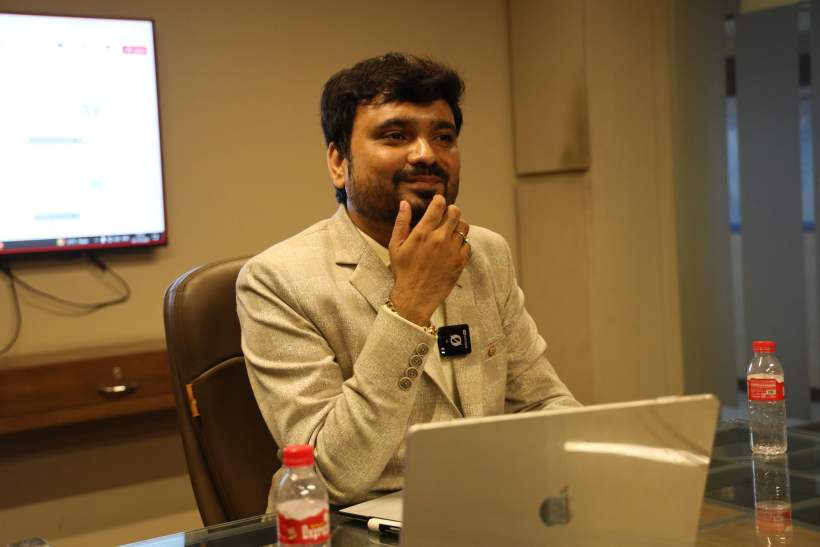

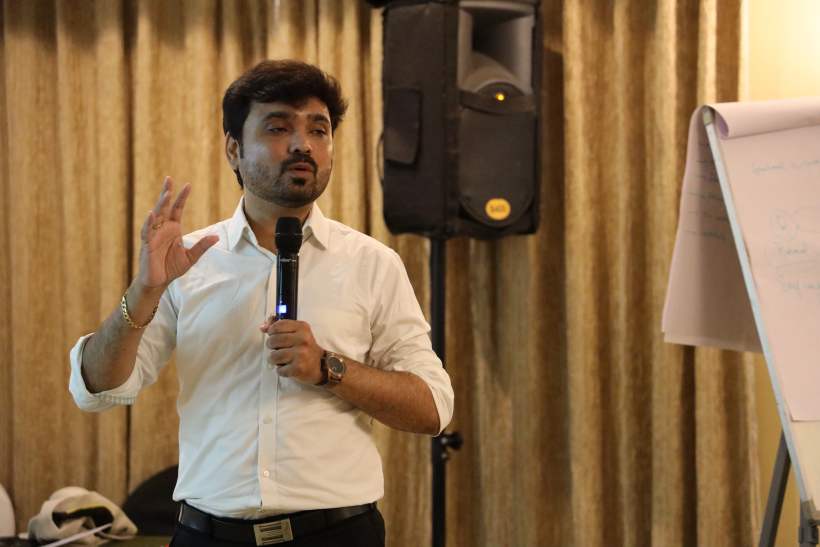
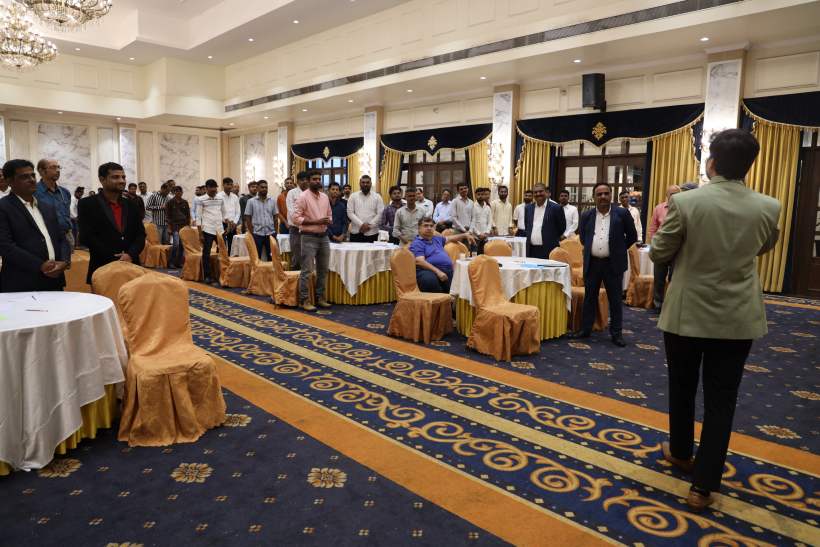
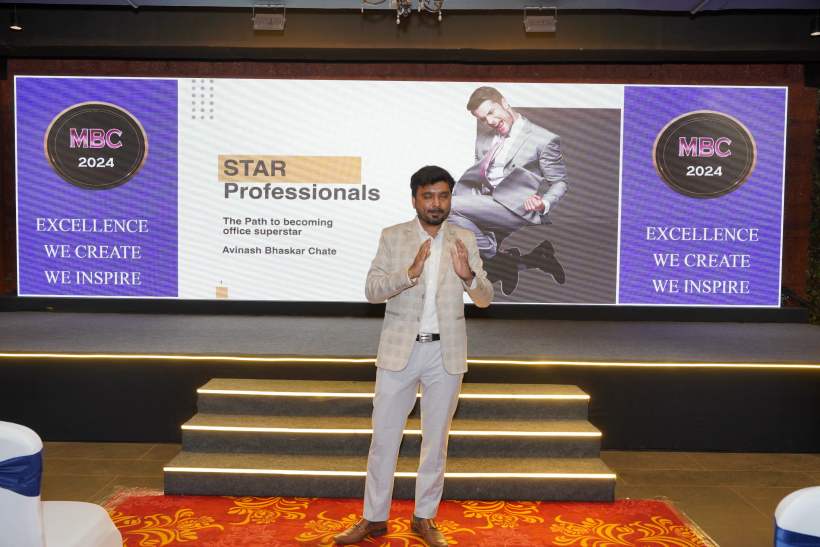
Photographs from Avinash Chate's own sessions in India. Sessions in this market are delivered by the same facilitator, in the same format.
Planning a training programme in the UAE?
Share your name and WhatsApp number and you will get a reply within one business day — usually the same day. Or call directly; scoping calls are quicker than email across time zones.
Prefer to talk now? ☎ +91 87936 30001 · WhatsApp · Email
Sectors and Cities Served
In Dubai the work divides cleanly. Financial and professional firms in DIFC, which reported a workforce above 50,000 in its 2025 results, and the technology and commodities companies in DMCC and Dubai Internet City buy leadership, presence and cross-functional work, in English. Logistics, freight, terminal and warehouse operations in Jafza and Jebel Ali, where Jafza says it supports more than 130,000 jobs, buy supervisor development and behavioural work — and that is the most South Asian workforce in the emirate. Hospitality, healthcare, retail and construction sit across both, with an English-speaking management layer and a frontline that is not. Those floors are where customer service training in Dubai does its work, while the commercial desks upstairs buy sales training in Dubai.
Abu Dhabi adds energy, industry and the professional firms around ADGM and Kezad; Sharjah adds manufacturing and port-side industry around Hamriyah Free Zone and the Sharjah Airport International Free Zone, where the shift is heavily South Asian. Sessions run in whichever emirate the team is in. Avinash Chate also travels for engagements elsewhere in the Gulf and across South Asia; those are taken one brief at a time rather than presented as markets with a standing presence.
Frequently Asked Questions
How does a UAE company engage an India-based corporate trainer?
Directly, in almost every case. Your own L&D or HR team contracts Avinash Chate to train your own employees, the same way you would contract any other specialist supplier — a brief, a written outline, agreed dates, an invoice raised from India. The other route is as the named facilitator under a training provider you already work with in Dubai. Whichever route you take, the person who writes the outline is the person who stands in the room.
What visa or work permit is needed for a visiting trainer?
The UAE has a mission work permit for exactly this: short, project-based work sponsored by the UAE host entity. It is single-entry, valid for up to 90 days, approved through MOHRE and then GDRFA or the free zone's own immigration portal, and it is your PRO who files it. A visit visa is not the compliant route for paid work, so plan the permit into the timeline rather than around it.
How much lead time is sensible for a session in the UAE?
Four to six weeks is comfortable. Three weeks is usually workable. Under two weeks depends entirely on what is already in the calendar and on how quickly your PRO can turn the permit around. Flying time from Mumbai to Dubai is a little over three hours, so travel is rarely the constraint — paperwork and your own internal sign-off usually are.
Which days of the week work for training in the UAE?
Saturday and Sunday are the weekend. Most private employers run Monday to Friday, while the federal government and most emirate governments work Monday to Thursday with a half day on Friday, and the Government of Sharjah works Monday to Thursday. Friday afternoon is thin almost everywhere. So the practical training week is Monday to Thursday, which is the reverse of India and the detail visiting trainers get wrong most often.
Are there times of year to avoid?
Two. During Ramadan the private-sector working day is reduced by two hours, which compresses any full-day format and makes a half day the sensible unit. And the peak of summer empties the training calendar across the Emirates. The clean windows are roughly September to early February and mid-March to June — which is worth knowing a quarter ahead, because those windows fill.
What group size does a session work for?
Workshop formats work best between fifteen and forty people, because that is the range where every person in the room still gets to speak. Below fifteen the session turns into facilitated coaching, which is useful but a different design. A keynote inside a conference or an annual town hall has no upper limit worth arguing about. For a large frontline population, the usual answer is the same session run several times rather than one very large room.
Which languages can the session run in?
English, Hindi and Marathi, and the same facilitator delivers all three. For a leadership group in DIFC or a technology team in Dubai Internet City the session runs in English. For supervisors and frontline teams in Jebel Ali, on a site or in a warehouse, it runs in Hindi. It is the same framework and the same trainer, not a junior stand-in assigned because of the language.
Can a session be delivered online instead of in person?
Yes, and for a group split across Dubai, Abu Dhabi and a plant elsewhere it is often the better answer. Online works well for a manager cohort meeting in short modules across a quarter. It works poorly for frontline behavioural work, where the room, the noise and the shared exercises are doing half the teaching. A common shape is one in-person block followed by online reinforcement.
What does a proposal contain?
The objective in your words, the audience and its level, the session outline hour by hour, the language for each group, the format and duration, what participants leave with, how the outcome will be reviewed afterwards, and the commercials with travel and permit responsibilities stated separately. It is written after a call, not before one, and you get it before any date is confirmed.
What does corporate training in the UAE cost?
It is built from the format and duration, the number of sessions, the group size, the languages involved, and travel and stay. A half-day workshop for one team and a three-month programme for a manager cohort are scoped differently, so a single figure would be guesswork. Two things are worth telling your finance team: the UAE currently applies withholding tax at 0 per cent on payments to non-residents, and under the VAT reverse charge a VAT-registered UAE client accounts for the VAT itself, so no UAE VAT registration is needed at this end. Share your brief and you get a specific quote within one business day — the fees guide explains how a proposal is put together.
Plan a Training Programme in the UAE
To scope it, share the emirate and the venue, who is in the room and at what level, the language each group needs, the date window you are working towards, and the one behaviour the session has to change. A call back inside 48 hours, then a written outline. The date is confirmed after that, never before it.
Training a team in Dubai, Abu Dhabi or Sharjah?
An India-based trainer who flies in — and runs the same session in English, Hindi or Marathi.
Check Date Availability →